



When Joel Rafidi said on a recent podcast episode that the phrase “screen time” is reductionist, it stopped me in my tracks.
I realised how much fear and control still sit beneath our cultural conversation about screens — and how easily that fear slips into the homes of even the most conscious, well-intentioned parents.
I used to be one of them. For years I’d proudly say, “We don’t really do screens,” as though I’d dodged some moral hazard. But in truth, the digital world was still there — surrounding us, evolving, shaping our children’s future — and my “no screens” stance was more reaction than reason.
Interestingly, as I’ve been sitting with this shift, I came across a new piece by Dr Naomi Fisher — one of the few psychologists speaking with real nuance about children’s autonomy and learning. She wrote, “Imagine if we treated paper like we do screens.”
It’s a brilliant thought experiment. We’d tell children they’ve had enough “papertime” after an hour of reading, forbid them from writing stories because they’d reached their daily quota, and worry that reading under the covers meant they were addicted to paper. Her piece is funny, but it also reveals the absurdity of how we’ve come to talk about technology. We’ve moralised an entire medium, instead of learning to understand and integrate it consciously.
Listening to Joel reframe the whole conversation was liberating. He explained his view that children learn to self-regulate only through experience, including the occasional “too much.” Shielding them completely, he suggested, often delays that learning. It struck a chord.
Because in home education — and in life — we’re not raising children to exist in a vacuum; we’re guiding them to navigate the world they’re inheriting.
What we miss when we label it all “screen time”
“Screen time” has become a catch-all term, yet it tells us almost nothing about the quality of what’s happening.
It doesn’t differentiate between a dopamine-fuelled scroll through TikTok and a child watching a documentary about coral reefs. It doesn’t account for the difference between passive consumption and active creation — or for the vast range of ways digital media can support learning, imagination, and social connection.
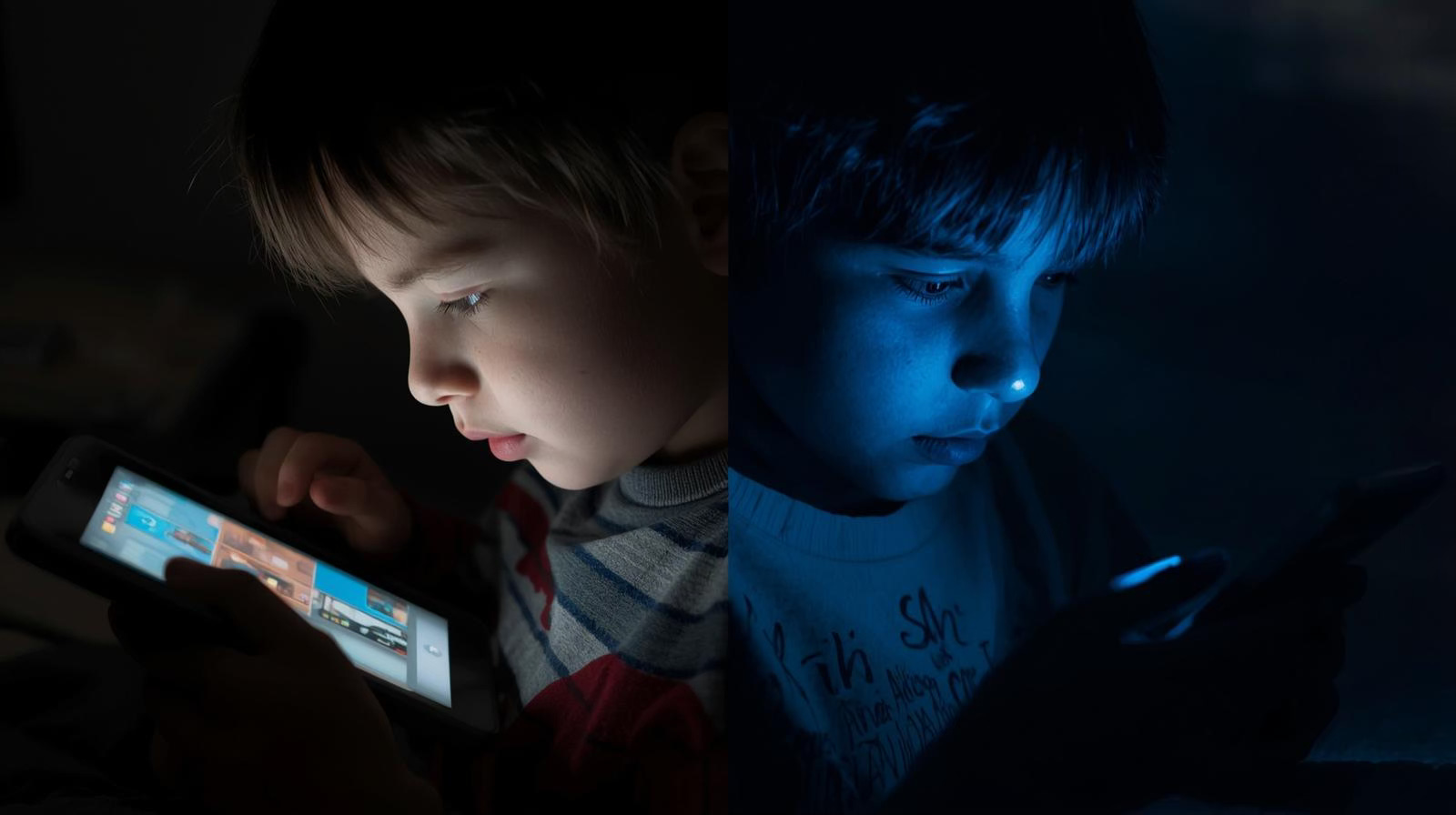
In our home, I’ve seen how rich the online world can be when approached consciously. My daughter’s regular screen use includes world culture & nature documentaries, animal rescue videos, slow animation storytelling, bushcraft tutorials, and educational games. The variety, rhythm, and intention behind it all matter more than the minutes on the clock.
Home education offers something traditional schooling rarely can: an unhurried day. That openness changes how screens fit into the fabric of life. They can become tools for curiosity rather than pacifiers for overstimulation. When our days include time outdoors, creative play, reading, conversation, and plenty of movement, a screen isn’t an escape — it’s simply one more doorway into learning.
We also live in a digital world that’s evolving at an exponential pace. AI, virtual reality, and online collaboration will be integral to our children’s adult lives. Pretending otherwise doesn’t prepare them; it disconnects them.
And many of today’s children are naturally right-brained, visually dominant learners — intuitive, image-based, imaginative. In Human Design terms, they often have open or receptive minds that learn through immersion and pattern recognition rather than step-by-step logic. For these children, visual media isn’t a distraction from learning — it is a form of learning.
When “screen time is bad” does apply
Of course, some screen use truly is harmful — and here, my intuition as a parent along with my background in Speech and Language Therapy has made that impossible to ignore. I’ve seen toddlers handed phones at every opportunity to keep them subdued; preschoolers clicking endlessly through flashing, meaningless games; and older children numbed by hours of YouTube shorts or TikTok loops designed to shock, entertain, and hijack attention.
These habits can delay language development, reduce social attunement, and overwhelm a young nervous system still learning how to regulate stimulation.
But here’s the nuance: that message — which was so necessary for one group of families — has now spread far beyond its intended audience. It’s landed heavily on the shoulders of already attuned, thoughtful parents. Those who are home educating, supporting non-linear learners and neurodivergent children, or consciously reshaping family life now carry unnecessary guilt over something that’s often not a problem at all.
If you’re a parent who already questions mainstream narratives, who watches, reflects, and adapts — please, take a breath. The “screen time” anxiety was never meant for you.
Conscious parents don’t need fear — they need frameworks

You are already tuned into your child’s nervous system. You already notice when something feels “off” — that glazed look, the short fuse, the subtle disconnection. You feel it in yourself, too. That sensitivity is your compass.
Sometimes screen-related dysregulation is immediate — a child goes from calm to chaos within minutes. Other times it builds quietly, and by the time you sense it, they’re already wired or flat. The key is to see these moments not as failures, but as feedback. Our role isn’t to eliminate stimulation altogether, but to help children learn to recognise and recover from it.
In our home, this has meant gentle recalibration rather than restriction. When our daughter watched too many bright, fast-paced cartoons, we noticed she became irritable and tense. So we shifted toward calmer shows, shorter bursts, and a wider variety — LEGO building tutorials, movement-based videos, educational programs with her dad, gentle animated films rather than multiple episodes of cartoons. We also made a family decision: no sustained personal device use at home. Screens are shared, collaborative, and part of the communal rhythm of our day. That simple structure changed everything.
From reflection to rhythm: a conscious approach to screens
So what might it look like to hold screens consciously — not fearfully, not rigidly, but as part of a living, responsive family culture?
Here’s the rhythm I return to when things feel out of balance. It isn’t a checklist to follow, but a process to attune to.
Step 1: Reflect & Reconnect
Get clear on your family values.
What do you want screens to support — connection, creativity, calm? Or are they filling a gap where rest or presence is needed instead?Feel into the “icky” moments.
Those subtle sensations of disconnection or overstimulation are information, not failure.Clarify what feels off.
Is it too much, too shallow, too solitary, too fast? The texture of imbalance often tells you what to adjust.
Step 2: Observe & Experiment
Look at the bigger picture.
Consider your child’s needs, sensitivities, and current phase — whether they’re de-schooling, emotionally processing, or just needing downtime.Tune into timing and context.
When are screens genuinely restorative, and when do they drain? Screens after outdoor play or social events may calm; screens after conflict may escalate.Keep a reflective notebook.
A few weeks of observations often reveal clear patterns.Try gentle structures.
Use natural transitions — a show before dinner, a timer, or a co-viewing ritual — rather than arbitrary limits.Experiment with content.
Mix entertainment with education, solo time with shared viewing, digital creativity with hands-on projects.
Step 3: Empower & Integrate
Invite your child into the process.
Ask how different shows make them feel in their body. Teach them to notice overstimulation and self-regulate.Communicate and collaborate.
Screens are part of family life — talk about them openly. Make decisions together, so boundaries feel co-created.Curate consciously.
Create a “menu” of trusted channels, creators, or games that align with your values and your child’s temperament.
A closing reflection
Perhaps the real shift we’re being asked to make isn’t to banish screens, but to bring them into consciousness — to see them as part of our evolving learning landscape. Our children will grow up in a digital world. Our role is not to protect them from it, but to model how to engage with it meaningfully, discerningly, and with awareness of our own nervous systems.
The screen isn’t the problem.
Disconnection is.

And just as Human Design reminds us there’s no one right way to learn, there’s no one right way to use technology. Each child’s design, sensitivity, and rhythm will show you what’s enough.
If this piece stirred something, I’d love to hear.
What have you begun to notice about how your child responds to different kinds of screen use — in their body, their mood, or their energy?
And what shifts when you respond to that, rather than the broader messages around you?
Your reflections often help other parents find their own way through this.
Subscribe below to receive future essays exploring what we see, what we miss, and what becomes possible when we look again at children and childhood.
Further Reading


Love this! I have felt SO much anxiety around screens with my son. But a lot of the time what he's doing is educational, related to his interests, and relaxing for him. The things he creates in Minecraft are amazing! Yes, there is also more "mindless" use of screens, because I just need a break as a homeschooling parent with very little outside support. But perfection isn't really the goal. We try to make screen time creative and social as much as possible.
Yes,100%. When my eldest is ill, he can't stand noise, and tends to hide in his bedroom watching YouTube science documentaries.
We had several days of illness this week and, the minute he was better, he said "I want to do some drawing". Sitting down on the floor with pen and paper, he embarked on a lengthy diagrammatic exploration of chemicals with different numbers of benzene rings.
Thus, a screen was definitely the best possible use of otherwise lost time, as he's not really ready for chemistry textbooks - especially not when he's ill.