


It was an ordinary day. An ordinary trip to the supermarket.
My two girls were piled into the trolley, helpfully taking up all the space the groceries needed. I was focused on getting everything we needed as quickly as possible before the two-year-old lost the plot and the seven-year-old had me buying out the toy department just to keep her quiet.
At a certain point, I noticed the older one was quieter than usual. Win, I thought. Don’t say anything. Crack on.
A few minutes later, I glanced at her again and realised what she was doing. She had snuck one of her “cardboard gadgets” out of the house. This particular creation looks remarkably like a smartphone, such is her skill with crafting and her fascination with technology.
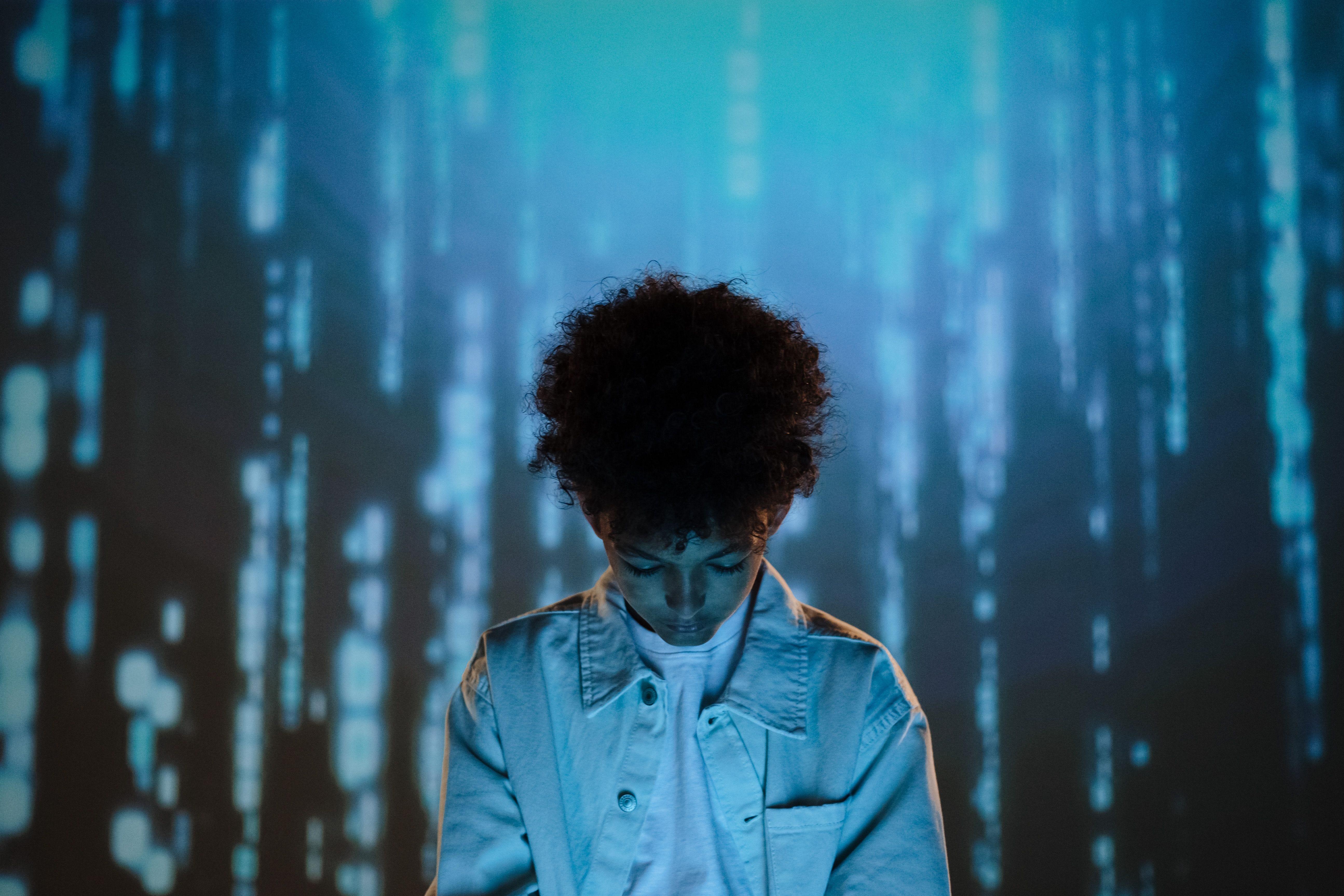
She had her head down, scrolling and tapping on this imaginary device, just like she sees other people do. She was completely absorbed in her fake phone, pretending to watch videos, take selfies and message friends.
In that moment, I was taken over by a visceral sense that I needed to get her to stop. She shouldn’t be doing this.
But underneath that was something else. What does it look like? A seven-year-old sitting in a shopping trolley, apparently engrossed in a smartphone. It looked exactly like everything I am not in favour of: children being placated, quietened and distracted by technology when they could instead be observing, absorbing and engaging with the world around them.
I experienced this bizarre internal struggle between knowing it wasn’t real and knowing that other people wouldn’t know that. What would they think of me? It was almost as though I wanted to shout to any onlookers: No! You have the wrong impression. I actually really value a natural childhood with thoughtful limits around screens. It’s NOT REAL!
These thoughts, which seem slightly unhinged now I write them out, took over. I ordered her to get off the pretend phone. She protested. “But why, Mum? That’s not fair! I’m pretending to play a fun game!” In classic harried-parent style, I shut her down with a “Because I said so” and promised we would talk about it later.
We did. But I can’t say I came to a settled point with it all, and I still haven’t. Because when I looked more closely at what had happened, I realised that something other than my daughter’s behaviour was going on here. And I wanted to understand what.
What was she actually doing?
I started with the most obvious question: what was my daughter actually doing? She was playing of course. She was imitating, imagining and exploring.
Since the dawn of time, children’s play has involved acting out the things they see in the world around them. My daughters copy their dad digging in the garden. They pour me imaginary cups of tea. They soothe a toy baby when it cries. They make little figures walk and talk, saying and doing things they have observed in everyday life.
I actively encourage all of this. And yet, when the thing being imitated was a smartphone, something in me suddenly wanted to shut it down.
This is complicated by the fact that I do have strong feelings about children’s relationship with technology. I have seen many disturbing disconnections that excessive and unconscious device use can bring, both through my work and beyond it.
I’ve seen a parent scrolling on a phone rather than responding to the baby cooing at her from the pram. A toddler watching an iPad rather than looking at the trees on the walk to the park. Parents moving young children from television to device and back again, then wondering why their speech and communication isn’t developing as they hoped. These things deeply concern me.
Yet technology isn’t some abstract future threat that we can simply keep away from our children. It is woven into everyday life. In our family, we use it for contacting friends and family, checking the weather, taking photos, making videos, parking, ordering shopping and countless other things.
We try to be conscious about this. We don’t endlessly scroll in front of the girls. We tell them what we are doing on the phone, and then put it away when we’re finished. But they only have to walk out of the front door to see devices in constant use.
So my values around technology are quite clear, but that wasn’t really the problem in the supermarket. The problem was that I suddenly felt a need to make those values visible to everyone around me.
I wasn’t simply thinking about what my daughter was doing. I was thinking about what her behaviour might communicate about me.

The audience that wasn’t there
Who exactly were these people I imagined judging me? I don’t know. There wasn’t a particular person standing there, looking at me disapprovingly. There was simply an imagined audience, and yet it was powerful enough to change my behaviour.
This has made me start paying more attention to the moments when my mind moves towards anticipating judgement before anyone has actually judged.
It happens surprisingly easily. A child having a meltdown in public, refusing to say hello, being loud in a café, or dressing in a way that doesn’t fit our idea of how they “should” look can all leave us suddenly aware of how their behaviour might be perceived by other people. Our attention can move quickly from What is happening here? to How does this look?
I think our children’s behaviour is a particularly powerful activator of this imagined gaze. We are so strongly conditioned into social conventions and social behaviours that how our children “come across” can become a fundamental preoccupation of parenting.
Parenting can become partly about managing how our children are perceived, because of how their behaviour reflects back on us. The child becomes a reflection of the parent, and suddenly what they are doing carries a significance far beyond the thing itself.
When perception becomes judgement
I became interested in why the things my daughter was imitating felt so uncomfortable to me in the first place.
Part of it is straightforward. I want her to enjoy being a child rather than becoming preoccupied with her appearance, social media, sharing her life and thinking about how she is being perceived. I imagined that a seven-year-old should still be fully embodying the moment rather than thinking about capturing it and sharing it with others — even if she was doing this entirely through pretend play.
But then I wondered what else I could be seeing. I could be seeing a child with an incredibly vivid imagination, fascinated by human behaviour and the tiny details of how people communicate, with a strong urge to connect and be sociable. A child taking something she sees everywhere in the world around her and transforming it into her own imaginative play, perhaps even beginning to explore and make sense of the strange complexities of growing up in a technological age.
My fears around the darker aspects of our culture undoubtedly play a part too. Grooming, over-sexualisation, social media and the many ways technology can distort childhood are all real concerns, worthy of awareness and conscious thought. But have I allowed those very real concerns to make an enormous imaginative leap from “this is something worth being thoughtful about” to “this particular moment of play is something I need to stop”? Maybe.
I think we are raising children at a time when the architecture of childhood, and society more broadly, is changing so rapidly that none of us really know what the right thing to do is. And when uncertainty meets deep love and a fierce instinct to protect our children from harm, it can create an urgent need to control.
Feeling judged can create a need to act, and taking control can feel like responsible parenting.
In the moment I ordered my daughter off her pretend phone, I felt relief. But what exactly had been relieved? She wasn’t in danger, wasn’t actually using a smartphone, and wasn’t even doing anything particularly unusual for a child. I had simply been uncomfortable with what I imagined other people might think, and taking control of her behaviour temporarily relieved me of that discomfort.
When control is really about us
This is the part that stings. If no one else had been around, would I have bothered to stop her? Possibly not. And that tells me something.
My daughter was playing. I was assigning all sorts of meanings to what she was doing and then reacting to those meanings. I had taken something quite simple and layered it with my fears, my values, my cultural associations, my imagined future and my imagined audience. Then I acted on all of that as though it were what was actually happening.
Of course there are times when we genuinely do need to intervene with our children. Parenting isn’t about permitting everything or never having boundaries. But I’ve started to notice the difference between an intervention that serves the child and one that primarily serves my own sense of safety.
What if I could allow my discomfort to exist without immediately making it my child’s problem? What if I could feel the tightening, notice the judgement, clock the imagined audience, and then simply give myself a little time before acting?
Because there is another possibility. I can simply look.
What becomes visible when I look again
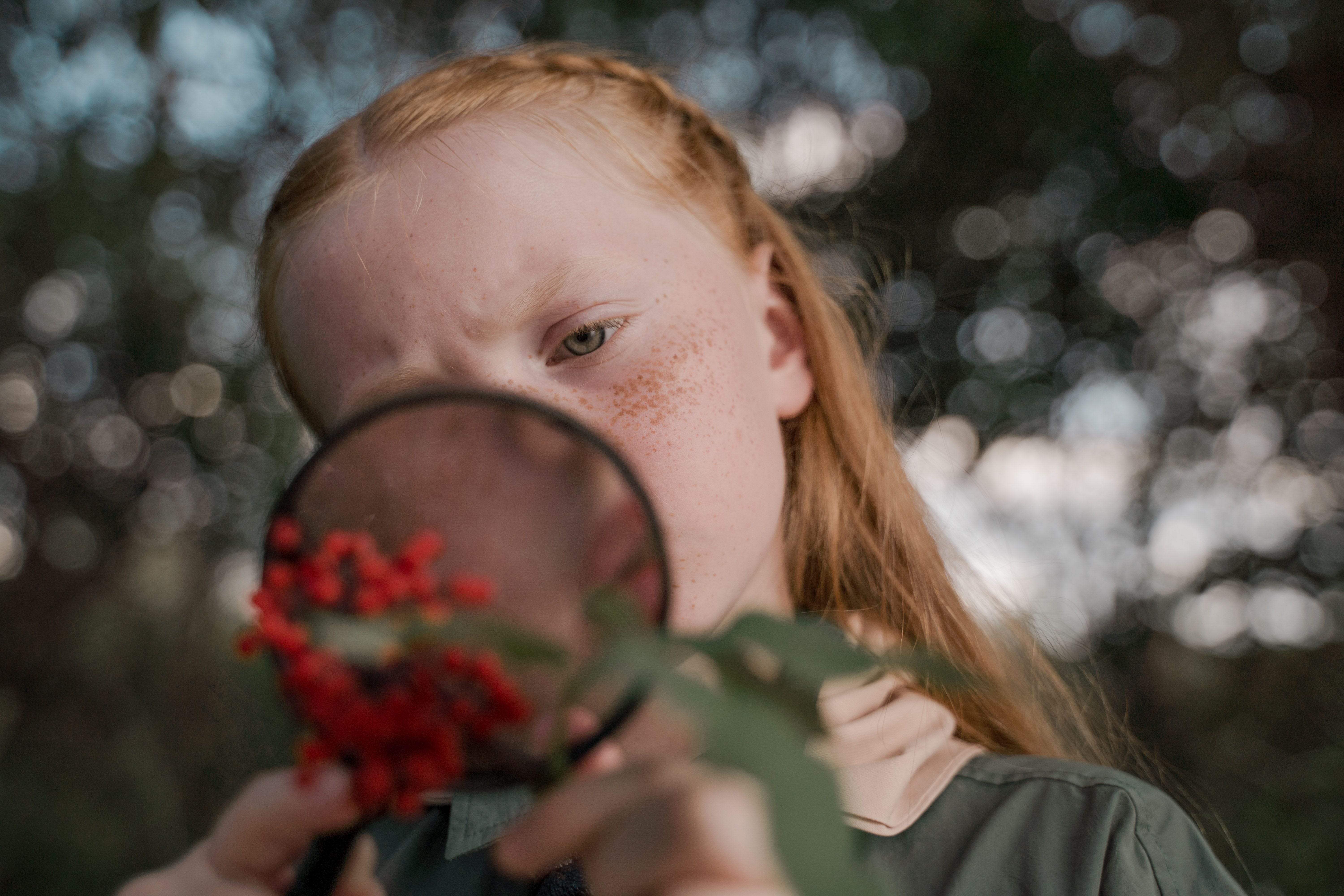
When I look back at that supermarket scene without all the noise I brought to it, I see an amazingly resourceful child.
She had used her natural creativity to make a remarkably realistic model of something she finds fascinating, then was happily occupying herself in her own imaginary world, which, incidentally, allowed me to get on with the shopping. In her play she was observing human behaviour, recreating ordinary interactions for the sheer fun of it, and experimenting with something that is simply part of the world she is growing up in. All without a real device in sight. How much of that had I missed in the moment?
Perhaps this is one of the saddest consequences of our own conditioning: it can obscure the child who is actually there and interrupt their expression. I had put my conditioning and myself before her, and in the process she received a message that something about this expression of herself was not acceptable or welcome.
I don’t think I need to decide that her play was definitely “good” or that my reaction was definitely “bad”. Perhaps the more useful thing is just to become better at noticing what is actually happening before I decide what it means, and to stay curious for a little longer, giving myself the chance to see the child before I start correcting the behaviour.
Perhaps our children show us our edges
This brings me to something I have pondered for some time. I sometimes wonder whether we are given — or perhaps encounter — the particular children we do because the unique combination of qualities they bring into our lives has something to show us about ourselves.
I remember when I was pregnant and found out I was carrying a girl. I was determined that she wasn’t going to be a “girly girl”, with all the pink and glitter and things I associated with what I saw as a somewhat shallow and narrow expression of femininity.
Fast forward three years and my daughter’s entire world was pink and glittery. It was a force I could not stop. Initially, I tried. Then, gradually, I began to see that this wasn’t some problematic expression I needed to eradicate. It was simply her.
Once I really saw that, I found myself first reluctantly, and later wholeheartedly, embracing it. Because how could I deny something that was so clearly part of her? In doing so, some of my rigid views and moral standpoints shifted a little. And I can now be grateful for that. She had woken something up in me that needed looking at.
I have no doubt that this patterning continues. I have a daughter who is deeply interested in appearance, makeup, beauty, selfies, vlogging and all of it. Rather than wishing she didn’t have these interests and trying to extinguish them, I am beginning to wonder what they are asking me to look at. Not because everything she does is necessarily something I should approve of. But because my reaction to it is telling me something.
There are deep-seated beliefs, fears, and layers of cultural conditioning here. There are questions about femininity, beauty, visibility, technology, social approval and what it means to grow up in this particular moment in history. Perhaps she is giving me a reason to look at all of that more honestly than I might otherwise have done.
Is it possible that the aspects of our children we find hardest to “allow” sometimes show us something about the edges of our own conditioning?
Returning to the relationship
The more I sit with this, the more it seems to come back to something quite simple: noticing what is actually happening before I jump in and react from what I think should be happening. To me, this is a key part of a more natural path in parenting and beyond — the return to something freer from our constructed ideals, something more present and connected to what is actually here.
In the supermarket, it was just me and my children. The imagined observer wasn’t real. Yet I allowed that imagined observer to enter the relationship and influence how I treated my daughter. Perhaps I can begin to notice when I am doing this.
Pausing creates enough space to reconnect with my own integrity — not the integrity of appearing to be the “right” kind of parent, but being able to distinguish my genuine values from the judgements I’ve inherited.
I can start to separate out what is mine from what is hers. What’s hers is to express herself, to play, to experiment, to encounter the world and gradually form her own relationship with it. What’s mine is to offer guidance, boundaries and the values of our family — and to examine the fears and conditioning I bring into that process.
And perhaps most importantly, I can try to keep the relationship central. Can I stay with her within the moment, even when we are in a social setting? Can I remain connected to her rather than managing her from outside the relationship? Can I meet the child in front of me rather than the child I imagine the world expects her to be?
Who are we parenting for?
I wonder how much of parenting takes place under the gaze of an audience that isn’t actually there. The imagined other parent. The imagined stranger. The imagined expert. The imagined judgement. Even the imagined version of the “good” child.
Sometimes these voices become so familiar that we no longer recognise them as voices at all. We mistake them for our own thoughts, our own instincts, even our own values. Perhaps the work isn’t to stop caring what anyone thinks, but to become aware of when that gaze has entered the relationship and started influencing how we see our child.
Because when I am preoccupied with how my child is being seen, I can lose sight of the person I am actually with.
It seems to me that parenting asks us to keep returning to that person. To look at what is really happening, to notice what we are bringing to it, and to give ourselves enough space to decide whether our response is genuinely needed.
And maybe, sometimes, the most useful question is simply: Who am I actually responding to right now?
If this piece stirred something, I’d love to hear.
Have you ever caught yourself responding to the imagined judgement of someone who wasn’t actually judging you?
And what have your children’s hardest-to-allow behaviours made you notice about yourself?
Subscribe below to receive future essays exploring what we see, what we miss, and what becomes possible when we look again at children and childhood.
This was such a thought-provoking piece Gem, I truly read enjoyed reading it.
Thank you for being vulnerable with your thoughts.
You really made me ponder with this sentence: Perhaps the work isn’t to stop caring what anyone thinks, but to become aware of when that gaze has entered the relationship and started influencing how we see our child.
As a mum of 2 boys, it often crosses my mind that I am caring about what anyone thinks, because like you said it said their behaviour is a reflection of me.
Your description of your daughter with her cardboard phone and playing with it, made me pause and think that my first thought would be very similar to yours. Given the fact that I am also very much against tech for my young boys. My boy pretend that they are typing on the laptop with a pretend toy they have at home at times. My husband and I just smile at each other. No doubt there is a flicker of worry but I know that is him letting his imagination run wild.
Another behaviour that makes it hard (especially for my husband) is that my boys love to dress up in girl dresses or princess clothes, or just take my hairband and pretend. Often, it cringes me, but I know it is pretend play for me, they are exploring their body, and they are having a lot of fun. A part of me thinks that because mama also wears dresses and hairbands, they want to follow what I wear. My husband has a harder time dealing with this, he allows it for a bit, until it causes him so much discomfort that he puts the dresses away.
I really enjoyed your reflectiont, thank you again for sharing.
What a trip down memory lane! This is a brilliant - and very familiar - description of my own unravelling of the pressure to pay attention to the imagined voice of social judgement that led me to focus on the child in front of me, in the here and now, who they are and their needs.
I don't think I quite mastered it during my children's childhood and I hope I'm a much better grandparent.