


Holidays are supposed to be joyful — yet for many parents, the reality of long stretches at home with our children can feel more draining than restorative.
The school holidays hadn’t even begun when I saw the Facebook ad:
“Feeling stressed about what you’ll do with the kids all summer?”
It stopped me mid-scroll. Not because it was shocking, but because it was so normal. So accepted. So expected.
And yet, it felt so sad.
This kind of messaging is everywhere — in ads, in conversation, in the subtle sighs of parents juggling overstimulation and exhaustion. Anecdotally, I hear it all the time:
“They’re doing my head in already.”
“I don’t know what to do with them.”
Which is why the question for me isn’t “how do I keep them busy?” but “what made free time with them feel so hard in the first place?”
What if the real issue isn’t the kids, or the holidays, but the system itself?
A system that has made unstructured time feel unnatural. That pushes parents to work or be busy constantly, to rely on school as both childcare and occupation, and then leaves us floundering when the structure falls away.
The Missing Village
Part of the challenge is that, for most of us, the “village” that once buffered family life simply isn’t there anymore.
In the past, children could play outside on a safe street, wander between neighbours’ houses, or be informally supervised by any number of familiar adults. Friends and relatives might drop in for a chat or to borrow something, naturally breaking up the long hours of the day.
Without this, parents are left carrying the full weight of their children’s constant energy. And children do have a different kind of energy. On my traditional Hatha yoga teacher training in India, I learned that children’s life force is spread evenly through their bodies, whereas in adults it’s more contained in the core — receding with age until it extinguishes at death. No wonder it can feel intense for us to be in their world for long stretches.
The loss of that village isn’t an accident — it’s a by-product of a culture built around capitalism and individualism. We’ve traded communal support for the promise of “more”, only to find the shine wearing thin.
Home Education communities offer glimpses of something closer to a village: meet-ups, co-ops, and long stretches of unstructured play. These parents still find the intensity challenging, but they often have more shared resources and solidarity. It’s not a full village — but it’s a step closer.
Zooming out, once that safety net disappears, the fixes we build — school, paid childcare, tightly timetabled lives — become both scaffolding and cage.
The Neatly Sewn Trap
School holidays come with inflated prices on travel, days out, and childcare. Term-time travel is penalised with fines. Parents working full-time rely on school not just for education, but as the structure that allows them to earn — caught in a loop: school enabling work, work enabling life, life dependent on school. Step off, and the carousel spins without you.
Many families would love to home educate, but can’t see a way out without a major lifestyle overhaul — downsizing home, car, holidays. Some make the leap, valuing time and freedom above all. Others find the trade-offs too steep.
It’s Cultural, Too
Psychologist Peter Gray has written about children’s right to play — and how our culture quietly erodes it. We over-structure their time, remove public play spaces, and expect them to be quiet or tucked away in “appropriate” settings. We’ve normalised the idea that children’s time must be organised, supervised, and productive.
Part of the discomfort many parents feel in long, unstructured stretches might go deeper than logistics. Children act as mirrors, reflecting back our own unhealed parts. They scratch at old wounds — many from how we ourselves were raised, often in stricter, less emotionally aware times, and sometimes reaching back through generations.
Modern Western life doesn’t encourage introspection. It rewards busyness, productivity, and measurable output. Quiet presence, rest, mindfulness, and contemplation are rarely held up as virtues — so we may unconsciously lead our children into the same busyness, believing it’s preparation for the “real world”.
But children live in the present by nature, and extended unstructured time with them can force us to do the same. Without distraction, we may be confronted with discomfort — the very feelings we’ve learned to outrun. This isn’t a judgement; I’ve felt it myself. Some of my shortest fuses have shown up on quiet days when “nothing much” was happening, and I’ve had to ask why that is.
My answer, and perhaps the beginning of a solution, is self-work. If we can make peace with stillness, with being in our own skin, we might find it easier to be in our children’s company without needing to fill every minute.
The Irony of Working With Other People’s Children
In schools and preschools, I often met mothers who had left other careers because education offered “family-friendly” hours. The irony was stark: they spent their days with other people’s children, just to secure the right kind of time with their own.
And yet, as we’ve already explored, many still found long stretches with their own kids challenging. The system has made it feel normal — even sensible — to outsource our children’s care and education to strangers while doing the same for someone else’s child. It’s inverted everything and sewn it up as “common sense.”
For many parents, working in a school is at least a step closer to their children’s world than a full-time job elsewhere that would require wraparound care or holiday clubs. But I think of all the children in the latter situation — how little unhurried, high-quality time they must have with their parents. The trade-off is often framed in financial terms: perhaps the family can afford multiple luxury holidays each year. And yet, children don’t measure connection in five-star ratings. The best memories are often the simplest.
Structure, Stuff, and Screens
The same forces that shape our working lives seep into our homes. Busy parents short on time (but not necessarily money) often turn to toys, devices, or structured activities to keep children occupied. I’ve seen playrooms bursting with things bought at great expense, but I often wonder how much of it truly gets used. Technology, too, can be a double-edged sword — offering a breather but often leaving everyone less grounded.
But when children aren’t constantly fed new distractions, they tend to create their own worlds from the simplest things.
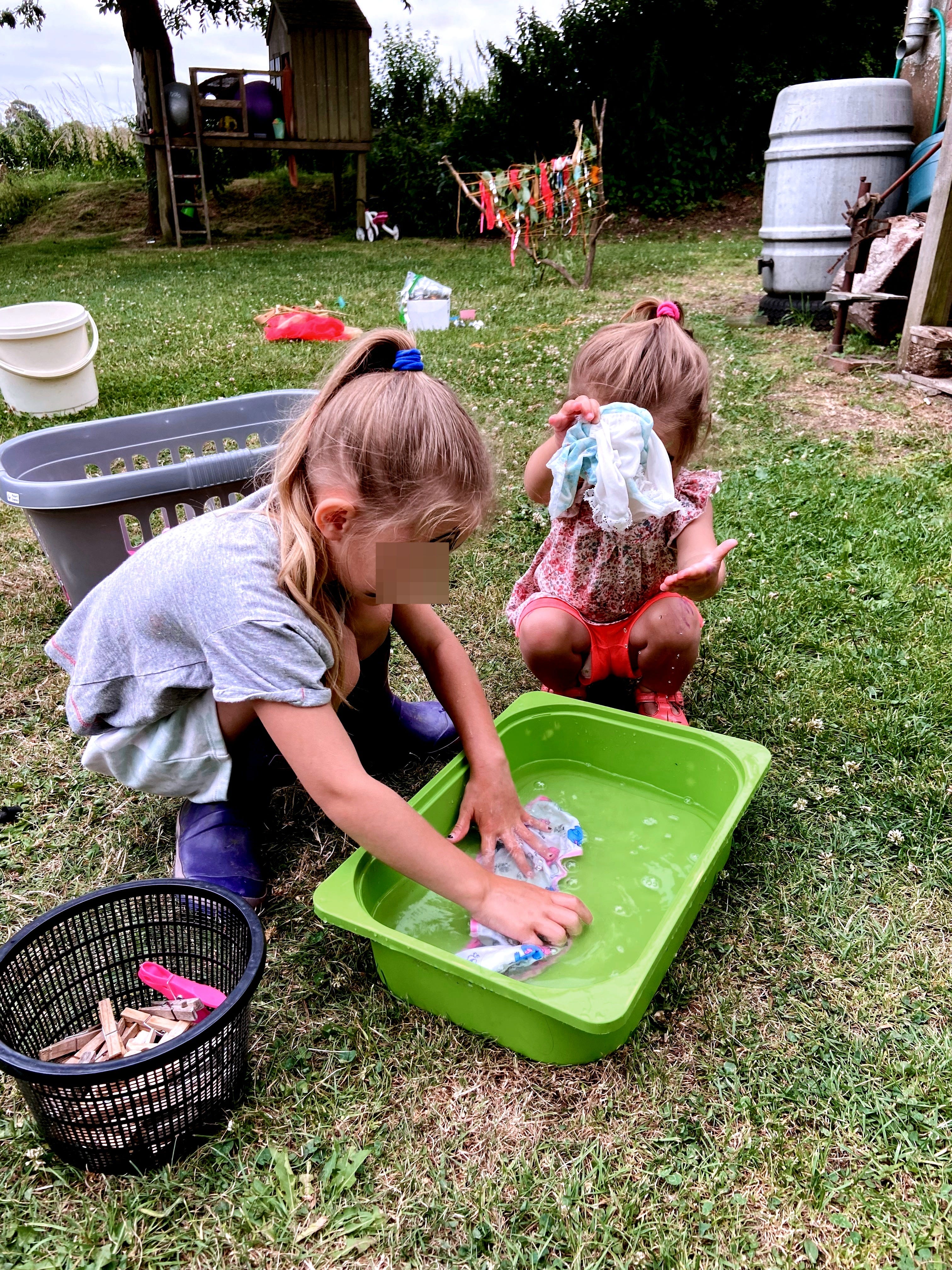
Which is why the stretches of “nothing” in summer aren’t empty at all — they’re often where the richest, self-chosen learning hides.
Repetition as Real Learning
Within the time-rich spaciousness of life without school, I’ve noticed my children returning to the same activities again and again. Babies learn to walk through endless repetition — but older children, too, deepen their understanding by circling back to familiar activities, play, stories, or games.
In school, there’s little room for this deep spiral learning. Material is covered once, maybe reviewed briefly, then the class moves on. Deadlines must be met rather than curiosity followed. At home, my daughter — a right-brained learner — might listen to the same audiobook dozens of times, each pass enriching her vocabulary and comprehension.
Unstructured time isn’t empty — it can be fertile ground for real learning, if we give it space.
What If We Flipped the Narrative?
Not everyone will Home Educate, and that’s fine. But what if we stopped framing school holidays as a problem to be managed — and started seeing them as an invitation?
Not to replicate school or craft Instagram-worthy schedules. But to slow down. To deprogram. To reconnect — not just with our kids, but with a different way of being.
The challenges are real, especially without support or with financial strain. But perhaps they’re not personal failings. Perhaps they’re the predictable result of a system that was never designed for family life to thrive.
Those of us who’ve stepped outside the mainstream know this:
It’s not easy.
It’s not always tidy.
And it’s certainly not encouraged.
But it can be deeply worth it.
If this resonated, I’d love to hear:
What feels hardest about the long stretches at home — and what, if anything, has surprised you?
Subscribe below to receive future essays exploring what we see, what we miss, and what becomes possible when we look again at children and childhood.
I totally agree with a lot of what you’ve written here! Instead of preaching to the choir, I’ll pull out the one piece I don’t fully agree with. You talk about the life force being more centralized in adults, and while I recognize this explanation as a cultural belief and even symbolic, I find it to be a bit lacking in explaining the disconnect between adults and young people—especially in terms of play. I do think you continue to explain one of the big reasons for the disconnect: the systems we exist in, especially the crushing weight of capitalism and all that it brings. I think play is possible (natural, even) in adults and mainly through burnout and a resultant lack of presence, curiosity, time, and general capacity that we lose that ability.
I think adults can play in similar ways as children but naturally, our play tends to shift based on our experience/age and interests. Pretend tea parties don’t have the same attraction to an adult because we’ve already explored those interpersonal relations so much that they’re just not interesting any more. But, at age 40 I still love a good game of tag with young people of any age—especially because I love all things movement. I still love wordplay and finding humor that connects for young people.
And I think Peter Gray (as awesome as he’s been to the movement) would laughably disagree with both of us in saying that children need to play with their peers away from adults. And that’s just not consistent with the reality I know.