


Opening Reflection: The Feeling Behind the Words
It’s a strange thing, how words meant to offer support and understanding can become unwieldy, heavy, or even harmful. The term Special Educational Needs — SEN — was obviously coined with good intentions. But like many labels, it has begun to carry cultural and emotional baggage that deserves deeper exploration.
We know this pattern all too well. Language created to describe difference or vulnerability often gets co-opted and twisted into tools of ridicule or exclusion. Take the evolution of terms like mentally retarded — once clinical and neutral, now firmly entrenched in derogatory slang. Even the word special, once intended to show care and distinct attention, is now weaponised in casual speech: "He's a bit special," often said with an eye-roll or smirk.
Working across Education, Health, and Speech and Language Therapy for two decades, I have been immersed in the world of SEN. I have sat in annual review meetings, drawn up countless support plans, assessed thousands of children, and worked alongside schools and parents trying their best. More recently, stepping outside the system as a Home Educating parent has given me another lens. It’s left me wondering: is this label still serving the children it's meant to? Or has it outlived its usefulness, becoming a catch-all that risks obscuring more than it reveals?
Unpacking the Language
What do we really mean when we say Special Educational Needs?
The word special is deeply ambiguous. Is it meant to suggest children who are exceptional? Struggling? Other? Broken? Worthy of extra care? It depends who you ask. Legislation doesn’t offer much clarity, and public understanding varies wildly. In the absence of precision, interpretation fills the gap. And culturally, special has slid into a vague placeholder for difference that doesn’t fit the mainstream.
Needs seems more straightforward at first glance. But even here, assumptions creep in. A need implies something essential — but essential to whom, and in what context? We all have needs. A calm space. A secure relationship. Space to move. Some of us need more or less of a given thing than others. When we label a child as having educational needs, are we speaking about their neurobiological reality, or their misalignment with an educational system built for efficiency and conformity? Are we being neutral — as the concept of a need really is, because we all have them — or do we feel overtones of deficit, lack, burden (something that must be met/accommodated), dependence, or vulnerability?

The reality is, in Education, a need is often a coded way of saying: this child doesn’t function the way the group is expected to. But expectations themselves are constructs. They are shaped by historical norms, dominant ideologies, available resources, and evolving curricula. How often are these re-evaluated? Are they representative? Are they kind?
The Problem With the Norm
Special compared to what?
This is the core question. Most of what we call SEN is only special in relation to an invisible baseline. A child who can't sit still, for example, isn't seen as having a need if their learning context involves movement and exploration. But in a typical classroom, their restlessness becomes a flag — a problem to solve.
Additionally, we have more and more “SEN children.” Official figures show 17% of children are on the SEN register in the UK (with EHCPs having risen by 139% from 2015–2023), and there are obviously many more navigating invisible or undiagnosed differences. So we could probably easily bump this up to 25%, if not more. Doesn’t that change the baseline of what normal development and behaviour actually looks like?
To me, it’s a really important question to ask: who defines the norm? And is it still valid?
In my work as a Speech and Language Therapist, I regularly used standardised assessments to determine where a child fell on the bell curve. Sometimes the answer was glaringly obvious: unintelligible speech in a 5-year-old, or a 7-year-old completely overwhelmed by classroom language. In those cases, you didn’t really need the norms to tell you there was a significant difficulty. But so often, children sat on the margins. One subtest might fall outside the "average range," while others remained technically fine. Then it was down to clinical judgement. That judgement, though guided by training, is unavoidably coloured by perspective, experience, and systemic pressure.
Even more complex were assessments for social communication — often the pre-diagnostic pathway to an autism assessment. These lacked even the illusion of norm-referenced objectivity. What counts as ‘socially appropriate’ is shaped by cultural, religious, and familial norms — and these vary enormously around the world. There’s no single, objective standard for how to be socially.

In one children’s health service I worked in, I co-led a redesign of our assessment process to better highlight strengths, reduce deficit-focused language, and create more space for pause and critical thinking in the face of pressure to categorise. Still, I left the process feeling uneasy about how many subjective biases we were baking into something trusted as structured and evidence-based. We never had any training where a group of therapists observed the same behaviours and were tested for consistent conclusions — and that concerned me.
These norms around attention, language, reading age, emotional regulation, and motor skills are either explicitly drawn on (like a clinician scoring a child’s test results against the average score of a large sample) or implicitly (like a class teacher feeling her pupil has problems because she can’t manage him in the classroom).
Explicit norms are drawn from large-scale developmental studies and psychometric tests. That’s somewhat reassuring, but I was still a little alarmed when I checked — in the case of one of the key language assessments Speech and Language Therapists use, the latest edition came out in 2013, meaning the norms must have been arrived at a year or two earlier at best. I also know from experience that SLT departments with limited budgets often can’t even afford to buy all therapists newer versions of assessments. So even in a best-case scenario, the norms will still be maybe 15 years out of date.
Additionally, these norms are shaped by Western, industrialised models of education. They assume linear progress and a standardised route through childhood. Many are also heavily influenced by what makes a classroom manageable: sitting still, following instructions, completing worksheets quietly.
So we may conclude that these norms are outdated — and not neutral. They reflect the priorities of the system: compliance, efficiency, academic achievement. And they don’t account for the vast natural variation in how children grow, learn, and express themselves.
And if so many children fall outside the standard, isn’t it time we re-examined the standard itself?
How the Label Shapes the Child
Labels have power. They can unlock resources, create understanding, and offer validation. But they can also constrain, stigmatise, and define a child in ways that stick.
Parents often feel trapped. Many I know didn’t want to seek a diagnosis. But they were driven to it — by desperation for support, by school and local education authority systems demanding paperwork before any help could be offered, by sheer survival. I’ve witnessed this personally too within my own family. And more broadly, I’ve seen how — rightly or wrongly — getting the label sometimes transforms the way adults treat a child. Suddenly, a behaviour is no longer laziness or defiance, but something to approach with compassion.
And yet, what mind is given to the child in all this, who also absorbs the label? Perhaps a quiet sense of “I am the problem” develops — which could colour the rest of their life.
In the Home Education community, I’ve seen a different picture. Parents can more easily set labels aside. Freed (mostly) from the need to conform to institutional frameworks, they focus on the child in front of them. Individualisation becomes the default. A child who couldn’t cope in school now flourishes. My own daughter — deeply creative, right-brained, with coordination challenges and past hearing issues — may well have attracted concern in school. But at home, without pressure to meet arbitrary benchmarks, she’s thriving in her own time.
When context shifts, so do our interpretations of ability and need.
Beyond the Label: A New Paradigm of Individuality
What if all children have special educational needs — or, more accurately, unique learning styles? What if difference is not the exception, but the rule?
It may be time to abandon binary thinking: normal vs disordered, neurotypical vs divergent. Every child is complex. Every nervous system is dynamic. As Ra Uru Hu said:
“Human Design is a tool to free you from the conditioning of society, to see yourself as you truly are — not as you have been told you should be. It reveals your unique design, your personal authority, and the way your energy flows best in this world. When you live your design, you are in harmony with your own nature, free from comparison, and radiant in your own authenticity.”
This framework, among others, has helped me see my daughter not as delayed or lacking, but as perfectly designed for her own path. Knowing her design has transformed how I support her — with trust, not worry.
I see this again and again in the Home Ed world: children once labelled as disruptive, resistant, behind, or anxious begin to shed those skins in a different, less pressured environment. A common story is that after a period of decompression, they start to learn again — joyfully, organically, freely. Groups of Home Educated children coming together feel like spaces where true inclusivity thrives. Free of rigid systems and the power-over dynamics necessary to impart a set agenda, everyone seems to meet each child exactly where they are.
So What Do We Call It Instead?
Educators and advocates in inclusive and alternative education circles use terms like learning diversity, individual learning profiles, and responsive education, alongside neurodivergence and learning differences, to describe the natural variation in how children learn and think — moving away from deficit-focused labels toward more affirming and inclusive language.
But perhaps new language alone won’t save us unless our values shift first.
Even the most well‑intentioned terms can start to feel hollow — or even harmful — if the systems around them remain rigid, outdated, or unjust. For example, while the word neurodivergent has opened up space for many to feel seen and understood, some researchers and advocates caution that it's becoming overused, politicised, or applied too broadly — particularly when used without acknowledging those with higher support needs.
Perhaps what we need most is a philosophy of individuation — seeing each child as a unique unfolding, not a deviation from a flawed norm.
Closing Reflection: What If We Started With Trust?
I don’t have a perfect quote or story to end on. But I picture my daughter on a gentle walk in nature, exclaiming with wonder as she points out plants and insects, asking brilliant questions about the world around her — questions we find answers to together when we return home. Later, she carefully creates a mini-habitat for a tiny caterpillar she finds. Over the coming days and weeks, we watch together as it transforms into a butterfly. No schedules, no boxes checked — just curiosity, patience, and the magic of learning unfolding naturally.
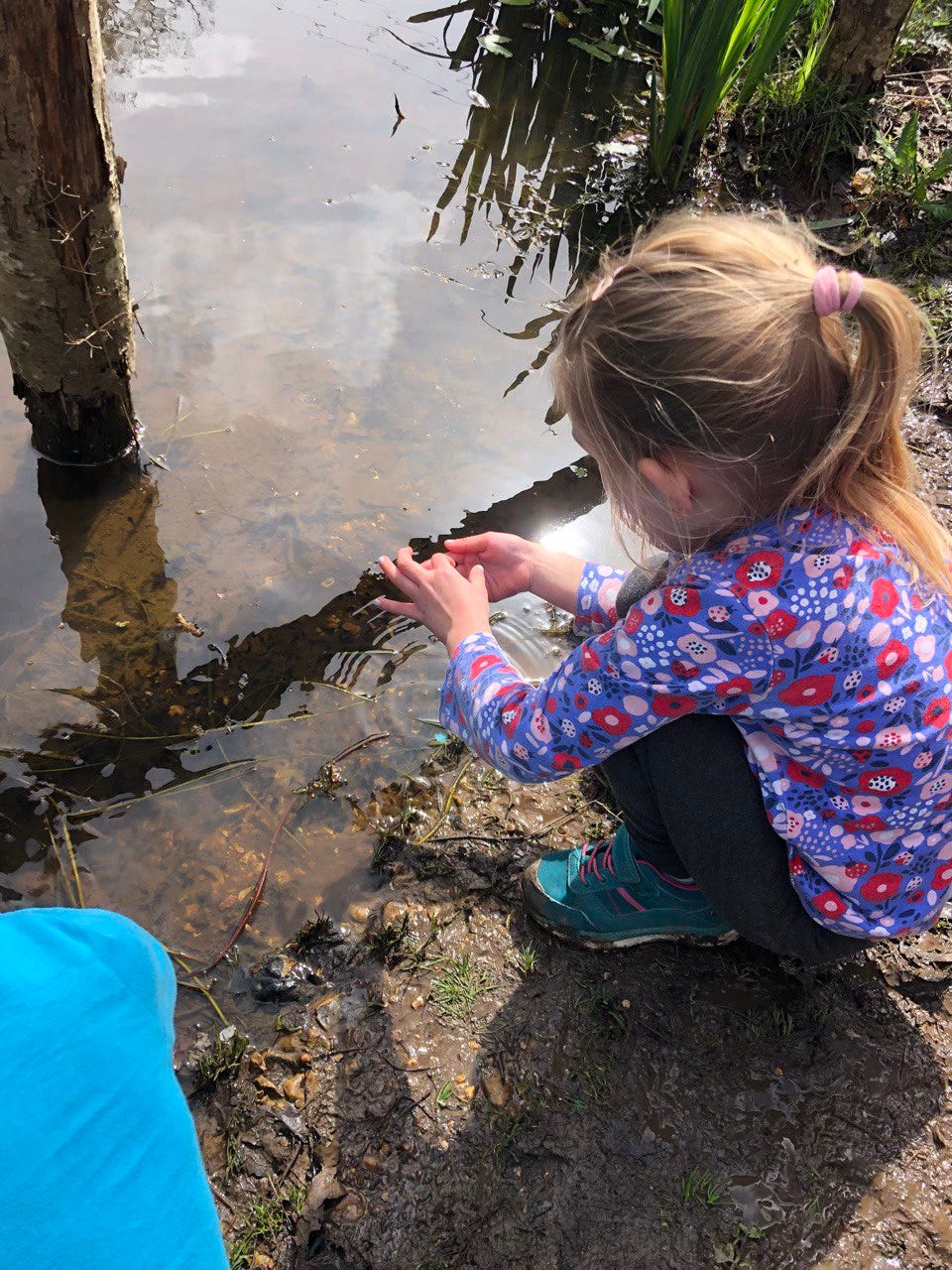
What if that was enough?
What if every child arrives whole — perfectly designed, bringing gifts the world is waiting for?
Our role isn’t to mould them into old shapes, but to truly see and accept them — so we can begin shaping a future that fits who they are becoming.
If this resonated, I’d love to hear:
Where have labels shaped how your child is seen — and what have you noticed when you begin to look beyond them?
Subscribe below to receive future essays exploring what we see, what we miss, and what becomes possible when we look again at children and childhood.
It's fascinating, isn't it?
I've got a wonderful learner who had 'extreme support needs' at school. At home, he's merely working eight years 'ahead' of age and doesn't like loud noises. Having read a book by a specialist, it's common for kids as academically gifted as he is to be emotionally intense, even without the sensory issues.
According to the book, he's apparently not especially unusual, but - while he was in school - he always felt like a very unusual problem that was hard to manage (no fault of the teachers. Everyone liked him).
At home, free to be himself, he is simply a gift.
It was so lovely to read this. Accepting a child’s uniqueness rather than giving them a label. As former teacher I often found it frustrating when parents wanted their child to be labelled almost to validate that their child was different.