


When Your Eyes Begin to Adjust
Stepping back from the schooling system has felt a lot like leaving a world of brilliant sunlight — so bright that your vision is bleached out — and then coming inside, where shadows and shapes start to make sense again. That dazzle was conditioning. Now, away from it, my eyes are finally seeing detail, nuance, life.
I used to walk past lines of uniformed schoolchildren at 3.15 pm and feel nothing. It was just the background of everyday life. Now, that same scene fills me with questions, a quiet grief, and a longing for something more.
Matching jumpers. Matching shoes. Matching hairbands. What is lost in that sameness?
This is the shift I want to explore: when neutrality becomes erasure, and when what once looked “just normal” becomes impossible to ignore.
The First Thing I Saw: The Loss of Identity
What hit me first, as I stepped away from the system, was how uniforms flatten who a child truly is.
In our home-education world, children show up exactly as they are. You’ll often see kids in eclectic outfits: part costume, part everyday; Christmas jumpers in April, face paint, colourful hair streaks, temporary tattoos, bold accessories. No rule-book. No approved list. Just self-expression in its most joyful form.
My daughter can change outfits multiple times a day. Sometimes her combinations are wild, clashing, unexpected — and I’ve had to remind myself not to say, “you can’t wear that.” Because part of her growth is exploration, and her clothes are the vehicle for that. Her freedom is her identity.
Meanwhile, on pavements nearby, I see row after row of identical, drably coloured children — legs, ties, blazers. It’s not just clothing. Its identity denied.
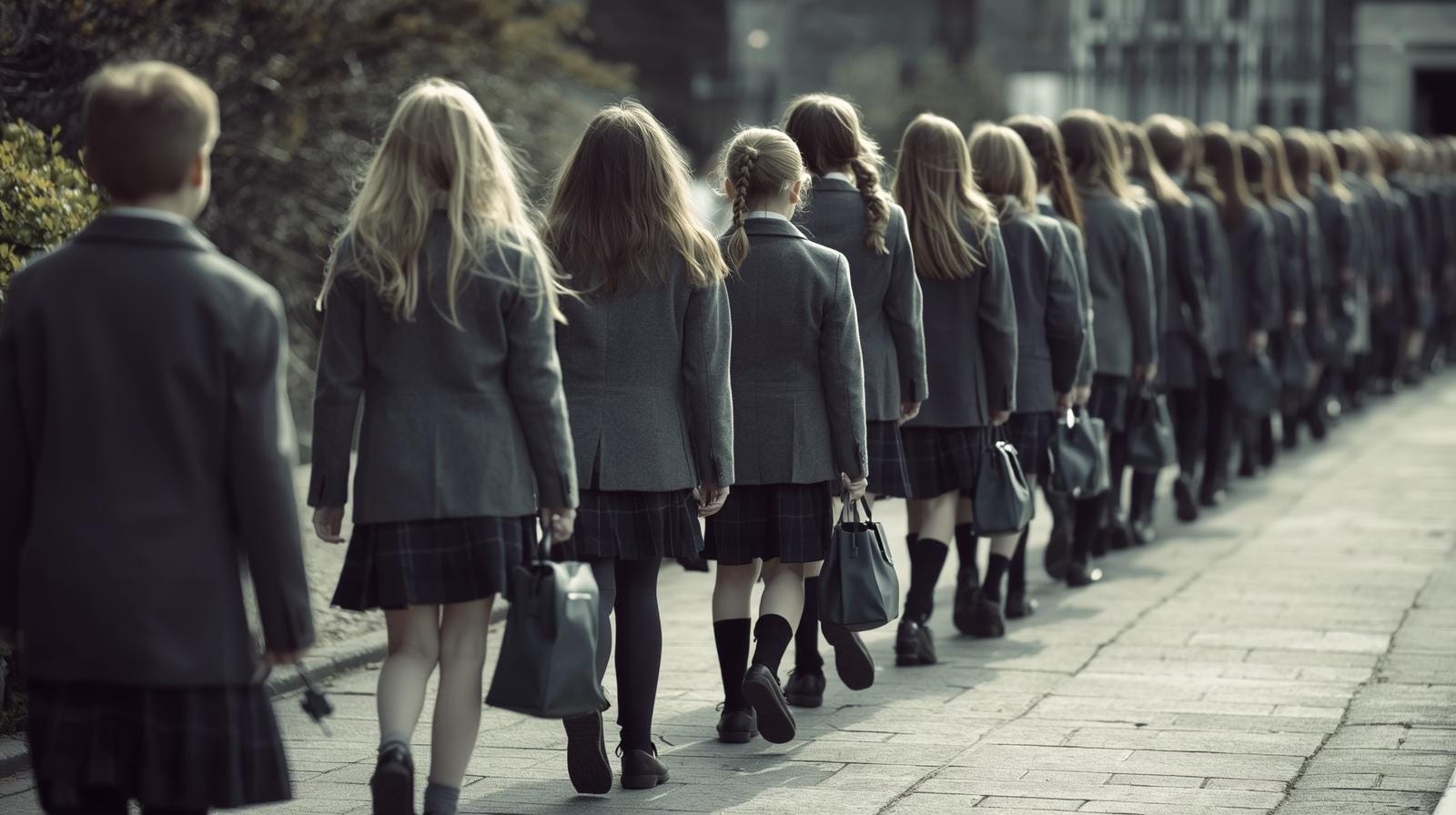
Even when teenagers try to express themselves — rolled up skirts, copied makeup — what ends up emerging is a new kind of conformity. Uniforms funnel all creativity through a narrow gate. What comes out isn’t individuality, but sanctioned sameness.
A Memory From Childhood: The Excitement of Non-Uniform Day
I remember how electric non-uniform days used to feel at school.
The buzz in the corridors. The laughter. The “this day is different” energy. We didn’t do any real work because we were too alive. For that one day, we got to be ourselves — playfully, fully.

But I also remember paying for it: fifty pence, maybe a pound, for the privilege of wearing our own clothes. It always felt a little strange, as though self-expression was a luxury, something to be fundraised for.
Now I wonder: if one day of choosing your own clothes feels so powerful, what does it do to children to be denied that choice for the other 189 days of the school year?
What Uniforms Are Really For: Conformity, Control, Compliance
Uniforms are often justified in terms of equality, discipline, and readiness for the “real world.” But there’s another, quieter purpose at play: conformity.
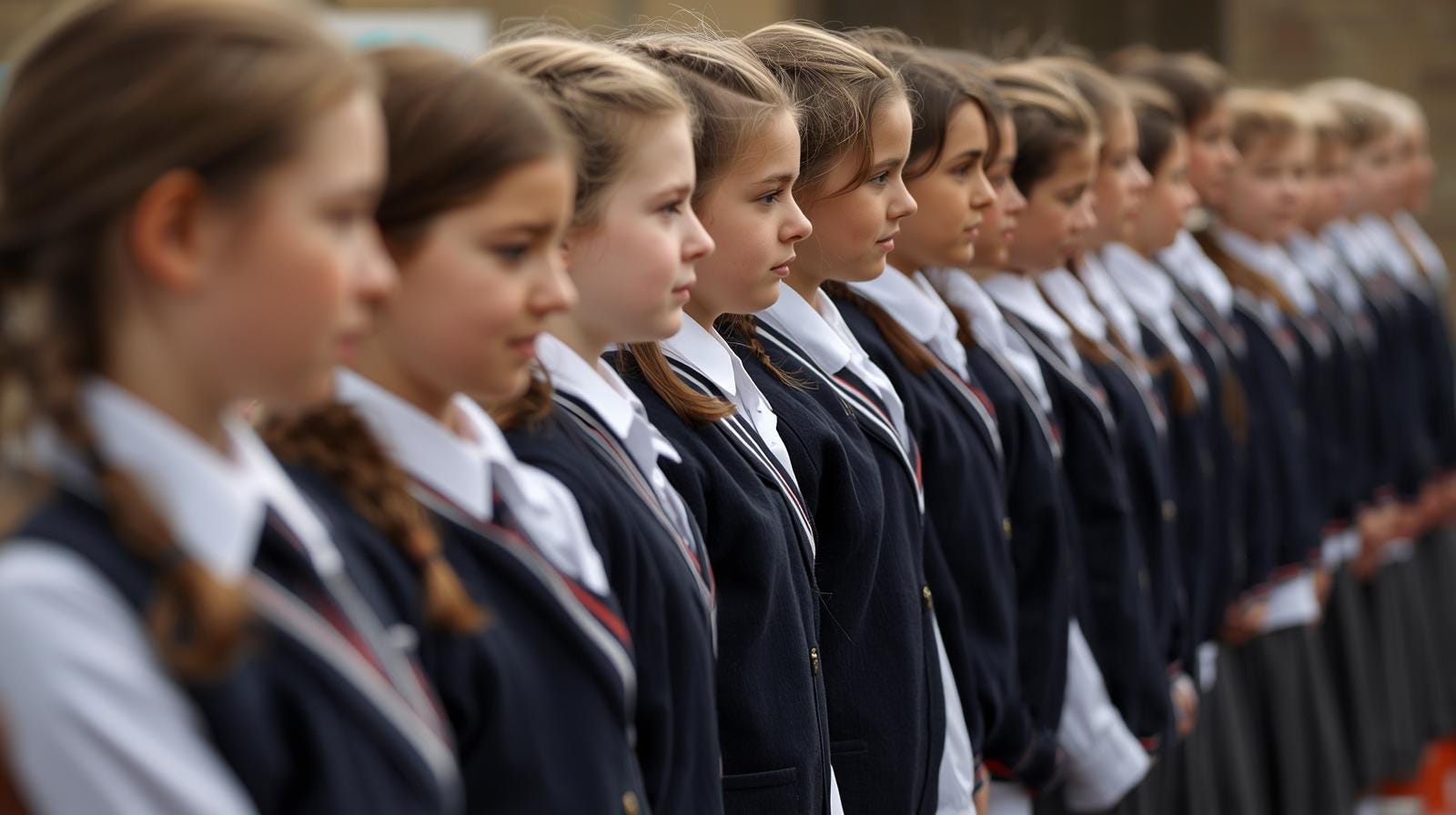
They make school populations visually uniform, which makes children easier to monitor. They reduce visible difference, reinforcing the idea that “difference” is a problem to be managed. They suggest that appearance is behaviour — that “looking like everyone else” helps you behave the same way, too.
I’ve carried out some research and there is no data to support the claim that uniforms improve academic outcomes. Their real power lies in behavioural control. Uniforms don’t teach children to think differently — they teach them to comply.
Uniforms and the Human Design G Centre: Identity, Direction, Lovability
Here’s a compact Human Design lens on what’s happening under the surface.
The G Centre is our energetic compass: identity, direction, and a feeling of lovability.
With a defined G Centre, there’s a stable, consistent inner self. But uniforms will pressure those children to dim their true identity, and they may later feel lost or off-course.
With an undefined G Centre, identity is naturally fluid and relational. These children thrive when they can experiment — but uniforms will shut that down.
In short: uniforms — worn for so much of childhood — interfere with identity formation at a deep energetic level.
In our non-school life, my daughter’s defined G Centre shows itself in how she dresses — with flair, confidence, and consistency. When I compare that with children in uniform, there is often a subtle but real dissonance: a lack of ease, a sense that something is muted or held back.
The Real Cost of Uniforms — Financial and Emotional
Uniforms are not just an emotional burden — they’re a financial one.
According to The Children’s Society, parents in the UK spend on average £337 a year for secondary uniforms and £315 for primary.
The same report found that many families cut back on essentials; one in eight reported reducing food spending to afford uniform.
Schools often require branded items, driving costs up even further.
A Guardian article highlights that branded uniforms can cost more than twice as much as high-street alternatives.
Us? We don’t spend this amount on clothes in one year for two children. We lean on hand-me-downs and unique charity-shop finds. And knowing other families are pushed into real hardship just to comply with uniform rules? It breaks something in me.
But more than the money, there’s the emotional weight: the shame, the exclusion, the constant worry that you’re not doing “school” right if you can’t afford their version of uniform.
What Uniforms Teach — and What They Silence
Uniforms don’t just tell a child how to dress. They whisper how to be.
They teach:
Don’t stand out.
Don’t question.
Blend in.
Conform to belong.
In a crowd of uniformed peers, individuality vanishes. That sameness can even make bullying more insidious; when no one is visually distinct, voices are harder to hear.
On the other hand, in our home-ed world, differences are celebrated. Children dress however they like. They express. They explore. Their identities breathe. My daughter’s boldness, her joy in her own style, resonates with a deeper truth — authenticity matters.
When children wear what they love, they show us who they are — and when they don’t, we lose something real.
A Life Without Uniforms: Colour, Wholeness, Expression
In home education communities, clothes are so much more than practical. They’re a tool for:
play
identity
emotional regulation
creativity
belonging
Children choose what to wear based on how they feel — and that choice changes day by day. Their outfits become part of how they learn who they are.
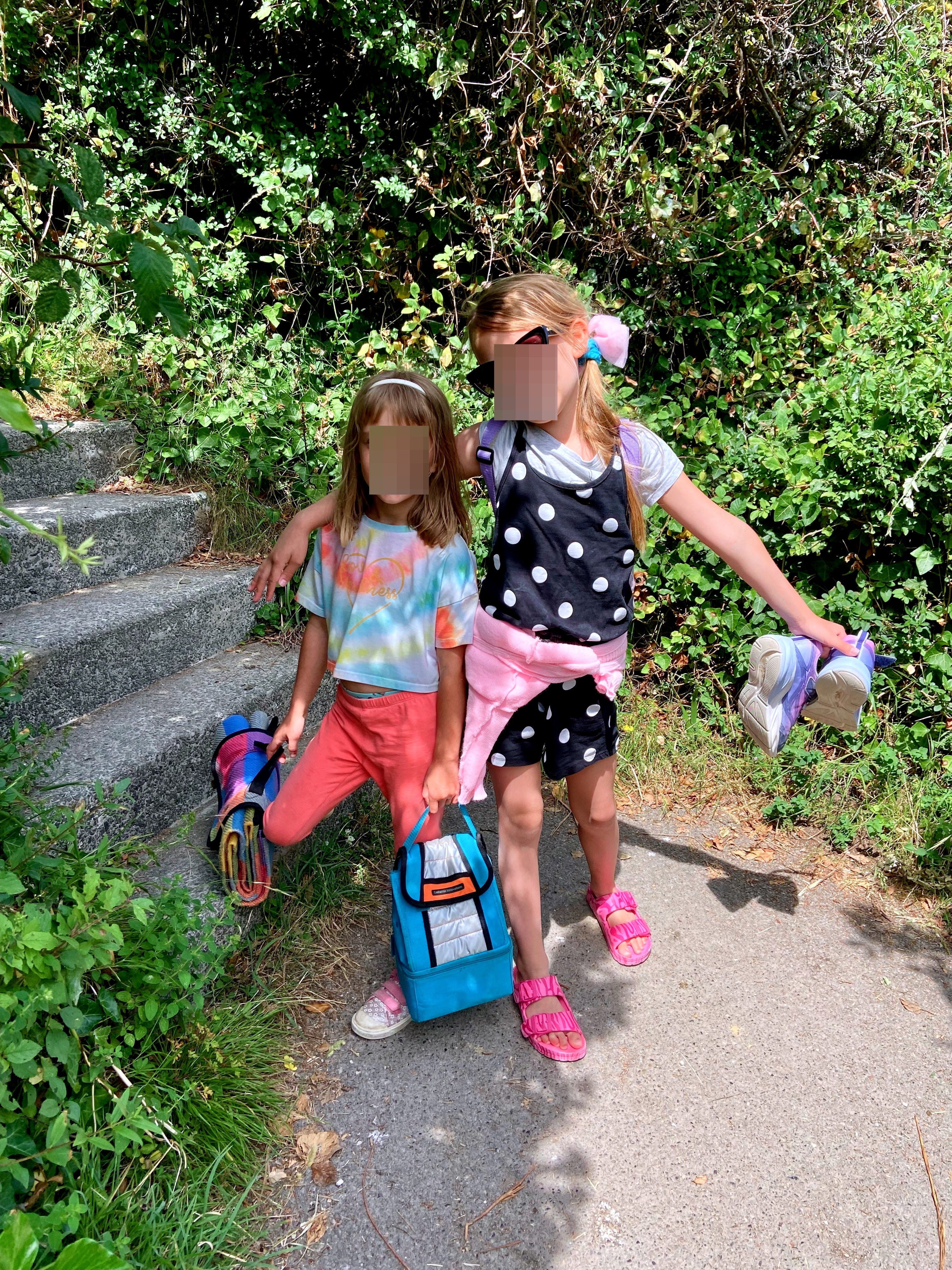
When you remove uniform, you make space for real self-expression. There is colour, texture, whimsy — and a sense that childhood is alive, messy, and beautiful.
Once You See It, You Can’t Unsee It
Uniforms no longer look neutral to me. They feel like a structure we’ve inherited without question — a system that demands sameness, but at the cost of individuality.
I’m not here to shame parents. I know many of us came up in the same system. This is about noticing. Rethinking. Asking: what might unfold in our children if we let them be fully themselves — even in something as simple, yet powerful, as what they wear?
Because once you really see it… there’s no going back.
If this piece stirred something, I’d love to hear.
What have you started to notice differently about the environments children move through each day?
And what do you see more clearly now that you might not have seen before?
Your reflections often help others recognise what’s been in front of them all along.
Subscribe below to receive future essays exploring what we see, what we miss, and what becomes possible when we look again at children and childhood.
Further reading


Great article. It is so ridiculous when children are sent home because they aren't wearing their blazer. Being denied access to learning because if an item of clothing. And autistic children needing uniform accommodations just to feel comfortable enough to learn. As you say, stepping away from the system reveals so many layers of control and conformity.
This is so interesting to read! I also wore uniforms as I got older and I was just talking about it the other day with my husband. Ever strange that I had to PAY someone to wear my own clothes. And I would get in trouble for not wearing something as simple as the right type of socks.
In a way, I found it was easy because I didn't have to pick anything out to wear each day. But I see now, especially as a mom, how it teaches conformity -- just much like the rest of the traditional education system.
Thanks for sharing your wisdom about how this shows up!