

When the Early Years Feel Gentle — and What Comes Later Doesn’t
How a Developmentally Sensitive Start Gives Way to an Academic Funnel

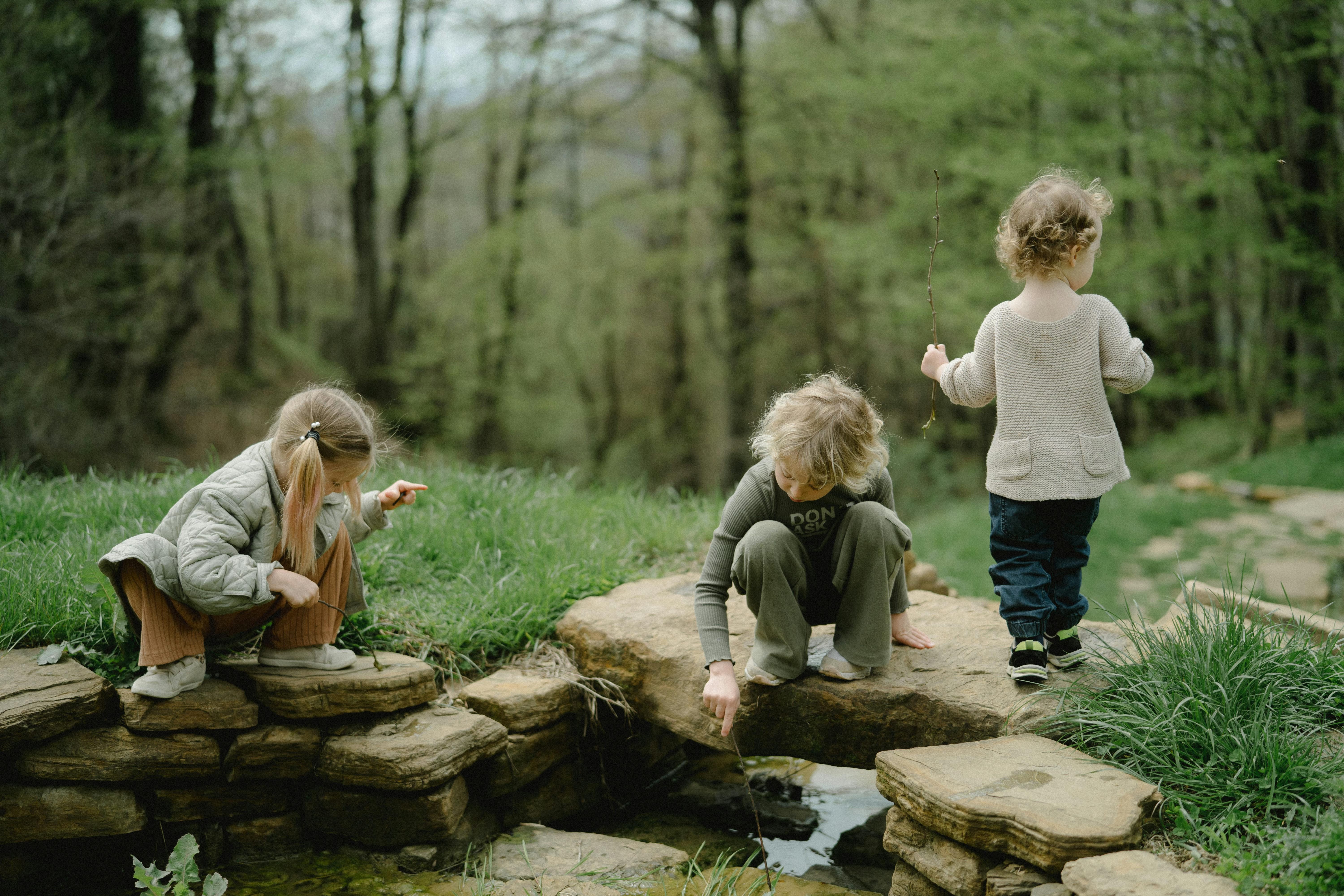
Sunlight filters through branches as leaves crunch underfoot. Children’s laughter and gentle singing drift across the clearing. It’s circle time at the nature nursery.
Toddlers swish towards their tree-stump seats while adults light a small campfire, wipe noses, and pass around a fruit bowl. Earlier there were blackberry mud pies and water-chute car races. Trees were climbed, ropes swung on, fairy gardens and bug hotels tended. Later, the children will cosy up inside a canvas yurt for stories and naps. Parents will collect them tired and content, reassured by muddy boots and smiling photos.
This, many parents think, is how it should be. And in that moment, they are not wrong.
The next day, those same children will be at home with a parent or grandparent — a quieter counterbalance to the busy nursery time. The week unfolds in this gentle rhythm: coming and going between home and early years provision.
For many young children, this is a familiar picture.
Why early years feel right
In the UK, Government-funded nursery and pre-school hours are available from age two. While some children attend full time, many families choose a lighter rhythm — fifteen hours perhaps, spread across a few mornings or days. It often feels like just enough: space for social connection and growing independence without overwhelming young nervous systems or disrupting primary attachments. Practically, it allows primary caregivers (most often mothers) to work. Emotionally, it reassures them that their child’s time away is nourishing and developmentally sound.
In recent years there has been a notable rise in outdoor-led and forest school–inspired provision. Time spent outdoors supports physical development, emotional regulation, sensory integration, and imaginative play — all foundational for learning later on.
Even in more traditional UK settings, practice is shaped by the Early Years Foundation Stage (EYFS): a play-based framework grounded in child development. There are no statutory academic targets before age five. Communication, physical development, social and emotional growth, and expressive play are prioritised. Literacy and numeracy are intended to emerge through experience, not pressure.
Through my professional life — and now as a parent — I’ve seen many examples of this working well. As a Speech and Language Therapist, I loved supporting practitioners to weave communication into children’s existing play, then returning to hear what had shifted. As a parent, I’ve stood on the other side too, reassured by muddy boots and smiling faces when my own daughter attended a forest school nursery.
In many ways, early years provision in the UK — and in similar early childhood systems — feels like a quiet success story.
The trust that forms
Part of what makes early years provision feel so right is the sense of ease it offers. Children settle. Parents relax. There is a felt sense of safety. The pace is slower, expectations looser, with emphasis on relationship and regulation rather than performance.
For parents, this often brings relief. Gratitude. A sense of alignment. This fits with what I believe about what children need.
From this grows something subtle but important: trust.
Trust in practitioners. Trust in the framework. And, quietly, trust in the wider system those early years settings belong to. When something feels this grounded, we rarely question where it is leading us. Trust has a way of shortening our horizon.

A soft entry into a harder system
Early years provision acts as a buffer — a gentle bridge between home life and institutional life. Entry into “the system” is gradual. There is no sudden rupture, no obvious red flag. Hours slowly increase. Nursery becomes Reception. Reception becomes Year One. The transition feels smooth, even kind.
At the same time, practical realities are reshaping family life. Free childcare makes working possible. Work patterns adjust. Financial commitments solidify. Lives quietly reorganise around the assumption of full-time education continuing into the future.
By the time children are fully inside the system, families’ lives are often built around it.
The years where nobody worries — yet
To be clear, this is not an argument about harm at three, four, or even five.
The first year of school often retains much of the warmth of early years practice. Play remains visible. Relationships matter. Even the early part of the second year can feel like an extension of this gentler phase. All of this reinforces the sense that things are fine — that the system is broadly responsive to children.
Questioning is delayed. At this stage, it is hard to justify doing so. I have stood exactly there.
Children, of course, are not uniform. They unfold at different rates and in different ways. Some move quickly towards abstract learning; others remain rooted longer in imaginative, physical, or relational modes. Some thrive with structure and repetition; others need spaciousness, movement, and absorption to stay well. Not all children are designed for the same tempo.
For a while, the system still stretches enough to hold that diversity.
When the pressure actually arrives
In my experience, the real strain often appears later — commonly between age seven and ten, sometimes beyond.
This is where the shift becomes unmistakable. Academic load increases. Behavioural expectations tighten. Time for movement, play, and self-directed exploration diminishes. The school day remains long and unyielding.

What begins to show up may not be dramatic at first: fatigue, anxiety, low-level resistance, a creeping sense that something is off. For some children, this grows into school refusal, physical symptoms, emotional shutdown, or explosive behaviour.
Across years of observing classrooms, certain patterns repeat themselves. In Reception, most children cope reasonably well, though many are already tired by the length of the day. In Year One, resistance often begins to surface as adult-led learning increases. By Year Two, the balance for many has tipped; school becomes something to be endured rather than enjoyed.
By Year Three, children with the lowest bandwidth — those with later developmental timelines, more sensitive nervous systems, or learning styles that are imaginative, hands-on, or deeply absorptive — begin to burn out. This is often the point where professionals like me are called in — not to question the system, but to locate what is “wrong” with the child. Why can’t this one cope like the others?
And yet this is often the same child who once thrived in the mud kitchen. Who sang in the circle with a clear voice and built elaborate worlds from sticks and stones. Who was described as curious, creative, and engaged.
From a nervous system perspective, this trajectory makes sense. Children can comply for long periods under pressure. Compliance, however, is not regulation. When demands consistently exceed a child’s capacity — particularly for rest, movement, autonomy, and meaning — their nervous system adapts in survival-oriented ways. They push through. They shut down. They act out.
This is not weakness. It is biology. Nor is it an argument against academic rigour per se. Children can thrive when challenged in ways that align with their aptitude, interests, and developmental timing. The concern arises when pressure is misaligned with a child’s readiness or capacity — overwhelming rather than supporting learning and growth.
While the structure varies by country, this pattern — a gentle beginning followed by steadily intensifying academic demands — is recognisable across much of the Western education world.
There is something quietly cruel about a system that begins so gently and only later reveals how narrow it becomes. By the time parents realise it is no longer right — no longer nourishing, sometimes no longer even safe — the trap has already been sewn shut.
Why families feel stuck
Once the strain becomes visible, many families discover how few options remain.
There is no mainstream part-time schooling pathway, and no flexible middle ground between full-time, intensive schooling and full withdrawal. The outdoor, relational models that flourish in the early years are rarely offered as a standard choice at school age, appearing instead as alternative provision once children have already failed to fit. Home education, while life-giving for some, is economically impossible for families who need to work.
I have lost count of the number of parents who have said to me, “I would love to home educate, but I can’t. I need to work.” I hear them. I feel them. I am one of them.
For those who do manage home education, it often requires reorganising work patterns — working part-time, freelancing, or sharing responsibilities — to create space for learning at home. Most families I know juggle employment and home education creatively, but these solutions are not universally accessible.
State support allows many parents to step back from work when children are infants, but this support ends early. By school age, most families are structurally dependent on full-time schooling. I often wonder how many would choose a different balance — perhaps part-time work paired with part-time schooling — if such an option genuinely existed. I suspect the number would be significant.
Instead, many parents grieve quietly: sensing that something is wrong, but unable to change it.
What the research quietly echoes
This is where research like Peter Gray’s becomes relevant — not as an academic hammer, but as validation of what many parents and practitioners already sense.
Gray and others point to a consistent pattern: early academic pressure may produce short-term gains, but it does not reliably support long-term wellbeing, nor long-term academic success.
In the UK, and in other countries that emphasise play-based, relational early years practice, this can be reassuring. Children are largely protected from academic pressure in their earliest years. The issue here is not early provision itself.
The issue is the academic funnel that follows, narrowing children’s worlds year by year.
The question isn’t whether early academics help children get ahead. It’s whether an academically driven system helps children remain whole.
The question we don’t ask
What would it mean to talk about consent in education — not as a legal concept, but as a developmental one?
Why does flexibility exist when children are youngest, and disappear just as demands intensify? Why are children expected to adapt endlessly, while systems remain rigid?
Why does educating our children feel so intuitive and humane in the early years, yet become something we must outsource for long hours once they reach “school age”?
Perhaps the most troubling part isn’t that children struggle later — but that by the time they do, there is so little room left to respond.

💬 Join the Conversation
I’d love to hear from you — what resonates here, or what surprised you? Your thoughts matter and can spark conversation that helps other parents too.
🔄 Share This Piece
If this article spoke to you, please consider sharing it. Someone in your network might need to read this today, and it helps us keep these conversations going.
✨ Free Mini Human Design Insight
Curious about how your child’s unique energy might shape their learning and development?
DM me for a free mini Human Design insight — a little guide to understanding your child’s natural rhythms and strengths.
🌱 Full 1:1 Sessions
For a deeper dive, I offer full 1:1 sessions where we explore your child’s unique blueprint in detail, including insights from Human Design. I help you understand and support your child’s learning, regulation, and creative potential in practical, everyday ways.


Couldn’t agree more. I homeschool my teen for this very reason. I’m in Australia and found that every year of her primary education chipped away at her little spirit and confidence in herself to become a compliant pleaser. I’m spending time unraveling that now. It took a while to recalibrate for both of us!
My daughter coped in Reception and by the end of year 1 she could no longer attend school. You have quite literally described my experience with my daughter.