


Field notes from everyday life-learning — small moments that quietly shape children's learning and growth.
You may notice this series has a new name.
What began as Home Ed Hacks gradually revealed itself to be something a little different. These pieces aren’t really about clever tips or shortcuts. They’re simply notes from walking the natural learning path with my children — moments, reflections, and discoveries that may resonate with others doing something similar.
So from this month onwards, this series will be called Field Notes from the Natural Learning Path.
The spirit remains exactly the same: sharing the rhythms, observations, and subtle shifts that shape learning in our home.
What follows are a few things that have been unfolding lately — observations that might open something up for you, too.
Gem 💎
1. Starting the Day with Sensory Play
I have a two-year-old and a nearly eight-year-old. Some people might hear that combination and think “nightmare” when it comes to meeting both of their needs in a home education context.
But like so much in life, I’ve found that letting go of expectations, comparisons, and imagined pressures allows things to flow more easily. This is the season we are in, and it has its own rhythm.
One simple thing that has been working beautifully for both girls lately is sensory play first thing in the morning. We rotate through things like kinetic sand, play-dough, slime, cornflour, shaving foam, or even something simple and mess-free like lentils in a tray.
For my toddler, this kind of play is foundational. Sensory exploration supports early brain development by strengthening neural pathways connected to touch, movement, and coordination. It helps develop fine motor skills, concentration, curiosity, and early problem-solving.
For my older daughter, the benefits are different but just as valuable. Sensory play is deeply regulating. It offers a gentle, body-based way to begin the day before the mind is asked to engage with more language or cognitive demands.
I’ve noticed that if we jump straight into anything “mental” in the morning, she can tire quickly and become irritable or dysregulated. On the other hand, if the girls immediately launch into energetic physical play together, things sometimes escalate into chaos before anyone is really ready for it.
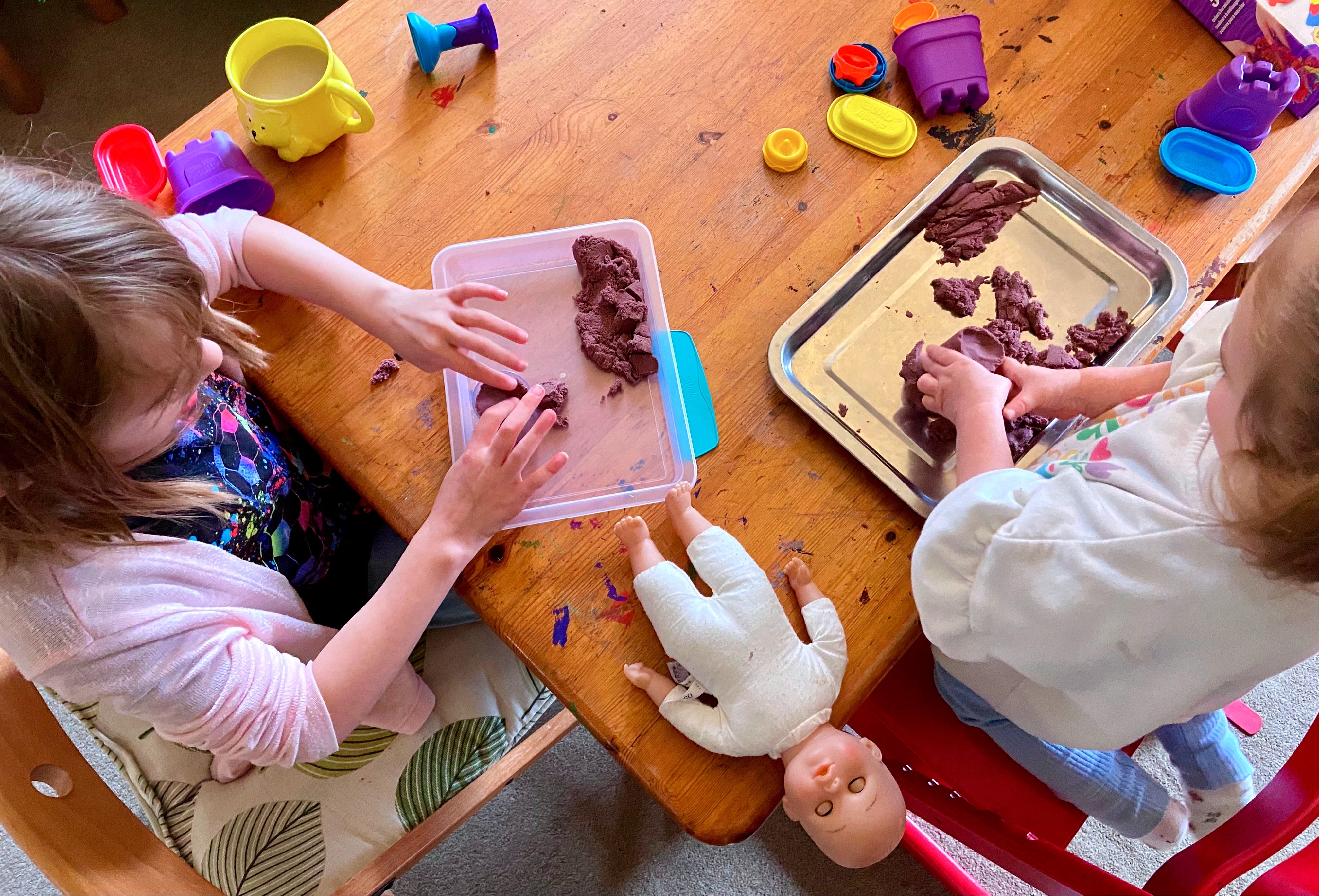
Sensory play seems to create the perfect middle ground. It keeps the atmosphere calm and contained, allows everyone’s nervous system to wake up gradually, and gives the thinking brain time to come online slowly.
A very practical bonus is that they are happily occupied while I prepare breakfast — which leads naturally into the next rhythm that has been working well for us.
2. Connection Over Breakfast
The long winter days can feel relentless at times. When we’re not able to get out and explore as much as we do in the spring and summer, I’ve been leaning more intentionally into the power of daily rhythms to create learning sparks at home.
During warmer months, the outside world constantly provides inspiration. A walk might lead to noticing a bird, which leads to a conversation, which leads to a book or drawing or experiment later. In winter, those sparks sometimes need to come from more inward sources.
Books have become one of those anchors for us — but not in a forced way. Like many children, mine go through phases of naturally gravitating toward the bookshelf and phases where they barely glance at it, even if I’ve carefully “strewn” interesting books around the house (a classic unschooling strategy).
Rather than trying to push reading, I’ve found that embedding it into an existing rhythm works far better.
After our slow sensory-play morning and once breakfast is ready, we sit together at the table. Each of the girls chooses a book or two, and I bring one as well. Once we’ve eaten (or once I’ve finished), we read.
Sometimes it’s a story. Sometimes it’s a non-fiction excerpt. Sometimes my older daughter wants to practise reading aloud.
The conversations that follow are often the most interesting part. A single page in a book might spark questions, ideas, or projects that ripple out into the rest of the day.
Another lovely side effect has been the growing independence around breakfast itself. My youngest loves pouring her own juice and practising cutting her toast, while recently my older daughter followed a simple recipe and made pancakes for us — a perfect blend of literacy, maths, and science woven naturally into real life.
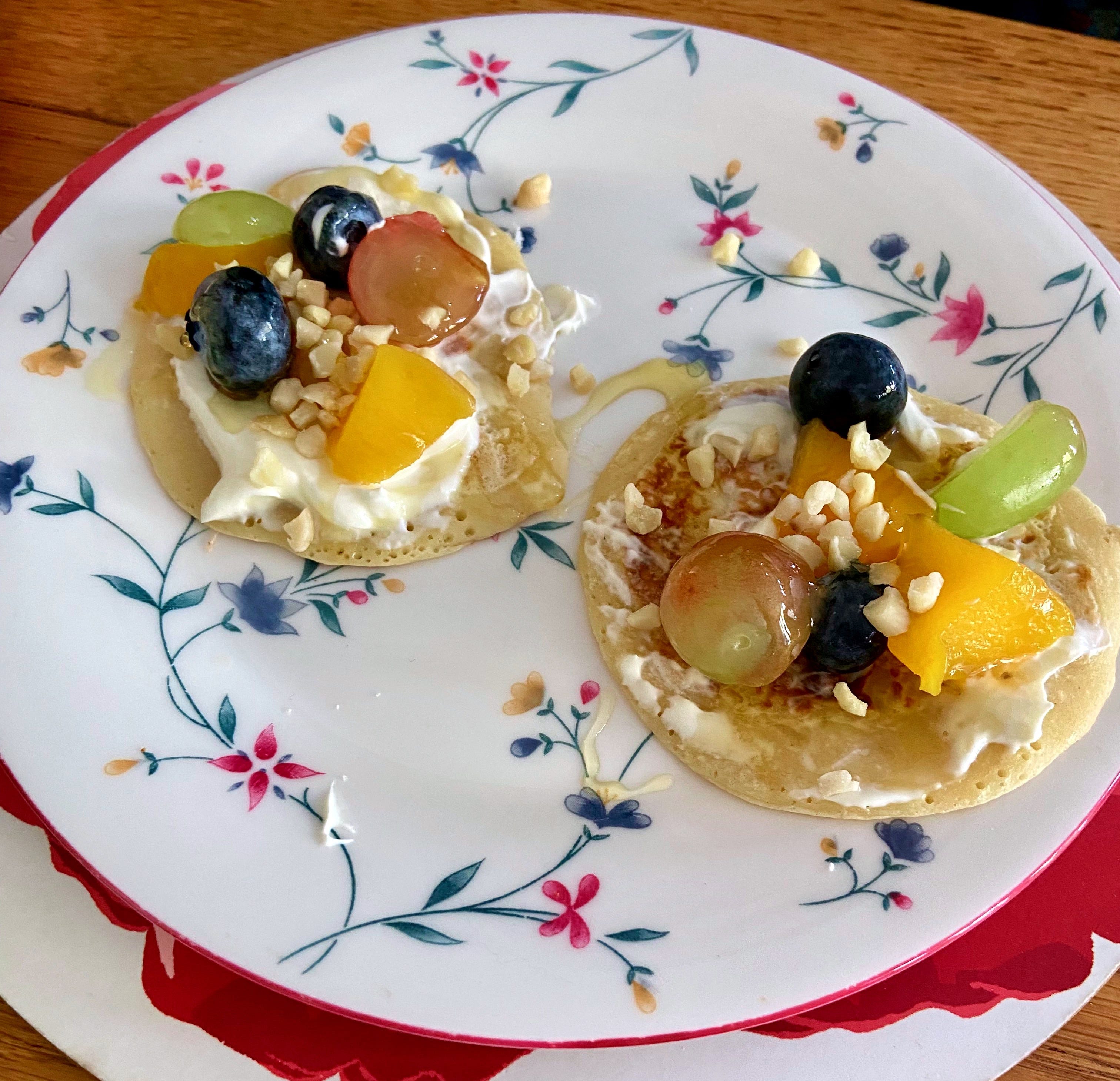
But perhaps the most important thing is simply the connection. These breakfasts are often full of laughter, curiosity, and shared attention, and they tend to set a tone of grounded calm that carries us into the rest of the day.
3. Rediscovering Maths in Everyday Life
Maths is something that causes anxiety for many people — children and parents alike.
Having taken a largely self-directed, readiness-based approach to my daughter’s literacy, I’ve watched in wonder as she has become fluent in reading and writing over the past few months with very little formal instruction. But numeracy has quietly lingered in the background of my mind — not as a problem exactly, but more as a question.
Partly because I know how foundational it is, and partly because both her dad and I found numbers much harder than words at school. I’ve also noticed that maths requires a kind of analytical, left-brain processing that can feel more effortful for her, and the few attempts we made at formal practice often met with resistance.
Recently though, something shifted in my thinking. It wasn’t a new idea so much as a moment of fully trusting something I already knew: that maths makes the most sense when it becomes interesting, useful, and embedded in life.
Not long after this realisation, something rather synchronistic happened.
One morning over breakfast, my daughter spontaneously began asking me little mental maths questions:
“If I gave you three of my grapes, how many would I have left?”
We started taking turns, gently stretching each other with small challenges. Over the following days she chose to make slime using recipes, and later began planning outfits in her fashion sketchbook. Both activities naturally required measuring, counting, and problem-solving.

Around the same time, I came across a couple of excellent articles that reinforced this shift in thinking. Psychologist Peter Gray has written about how many students who perform well in school maths still struggle to actually understand how numbers work in real life. They learn procedures, but not meaning.
He also describes research suggesting that children who are not formally taught maths until later can actually outperform peers in mathematical reasoning — because their everyday experiences with numbers remain connected to common sense rather than abstract rules.
Similarly, educator Katy Purviance writes:
“When children learn mathematics through building, cooking, or figuring out how to split resources fairly, the concepts attach to real purposes. When children memorise formulas for a test, the knowledge often evaporates because it was never connected to anything that mattered.”
For me, this has been another moment of letting go. Instead of worrying about whether maths is “being covered,” I’m trusting that — just like literacy — understanding will bloom when the conditions are right and mathematical thinking begins to arise naturally in everyday life.
4. Personalised Stories (and AI as a Helper)
When I worked as a Speech and Language Therapist, I often used an approach called Social Stories, developed by Carol Gray. These are descriptive, personalised stories designed to explain situations, behaviours, or social expectations in a clear and engaging way.
One reason they work so well is that they make abstract ideas concrete and allow children to revisit the information at their own pace.
Over the years, after carefully analysing the specific situation and context, I wrote many of these stories from scratch, trying to make them clear, accurate, and engaging. Today, tools like AI can make the writing itself far easier.
Recently my daughter went through a few days where her attention seemed particularly scattered. She would begin conversations and drift away mid-sentence, or ask the same questions repeatedly. Rather than becoming frustrated, I wondered whether a lack of information might be part of the picture.
Carol Gray often emphasises that anxiety, resistance, or confusing behaviour can arise simply because a child doesn’t yet understand something.
After talking it through with AI, I created a short explanation sheet describing how her brain works — explaining the difference between the “fast” and “slow” parts of the brain and suggesting simple strategies to help the slower, executive-function part come online.
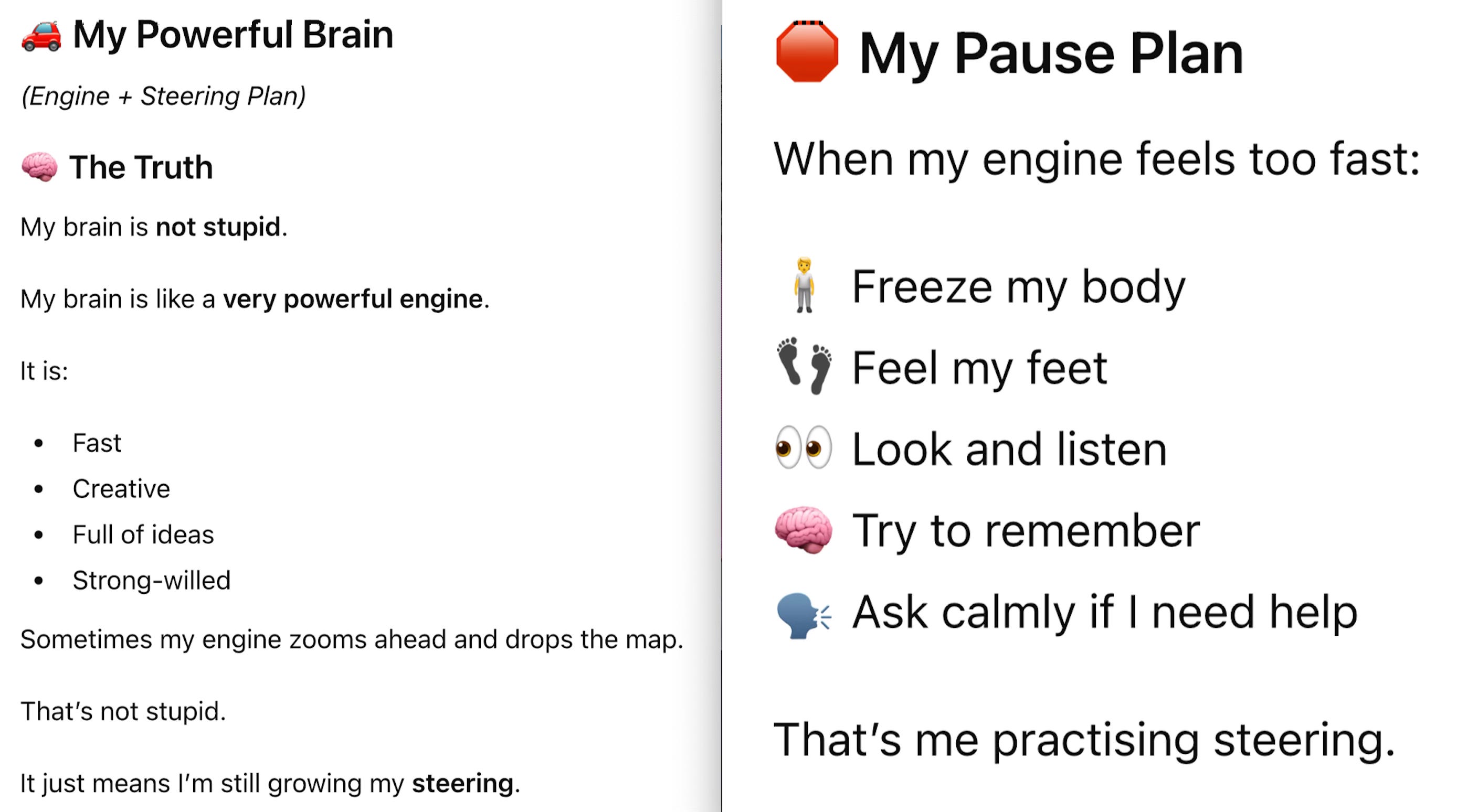
P listened with interest and immediately tried one of the grounding techniques we had discussed.
Looking back, I could easily have asked AI to turn that explanation into a personalised story, which might have been even more engaging. This is something I now recommend to parents quite often.
This idea of using AI as a tool for thoughtful, truthful communication with children is something I explored more deeply in a collaborative piece with Slow AI called How Can You Use AI to Speak Truths to a Child? — a quiet exercise for carers and educators who want clarity rather than noise.
If your child is struggling with something specific — whether it’s emotional regulation, safety, social understanding, or even something practical like wearing a seatbelt — a personalised story can be incredibly powerful. AI can help generate a first draft in seconds — with simple visuals if you ask it — which you can then tweak to make it truly yours. Used thoughtfully, it can become another way of helping a child understand what’s happening around them and inside them.
5. The Power of Free Play
Recently I’ve also been reflecting on the role of unstructured play with peers in children’s development.
Teacher and writer Kevin Stinehart recently wrote something that resonated deeply with me: many of the skills we say we want children to develop — resilience, initiative, emotional regulation — actually grow through ordinary, low-stakes experiences with other children.
Not through carefully designed programmes, but through real life: children figuring out the rules of a game without adults refereeing, navigating small disagreements, feeling boredom and deciding what to do next, making mistakes and adjusting.
As I wrote when I shared his article recently:
The skills we say we want — resilience, regulation, initiative — aren’t built through tighter control. They’re built through real-world practice.
Research even suggests that children who spend more time in unstructured play show stronger executive functioning skills — the very abilities that underpin learning.
These reflections reassure me that our current rhythm feels balanced. As well as attending a couple of taught activities each week, P has regular opportunities for extended free play with close friends, and also participates in semi-structured environments like our home-education co-op and a forest-school-style outdoor group.
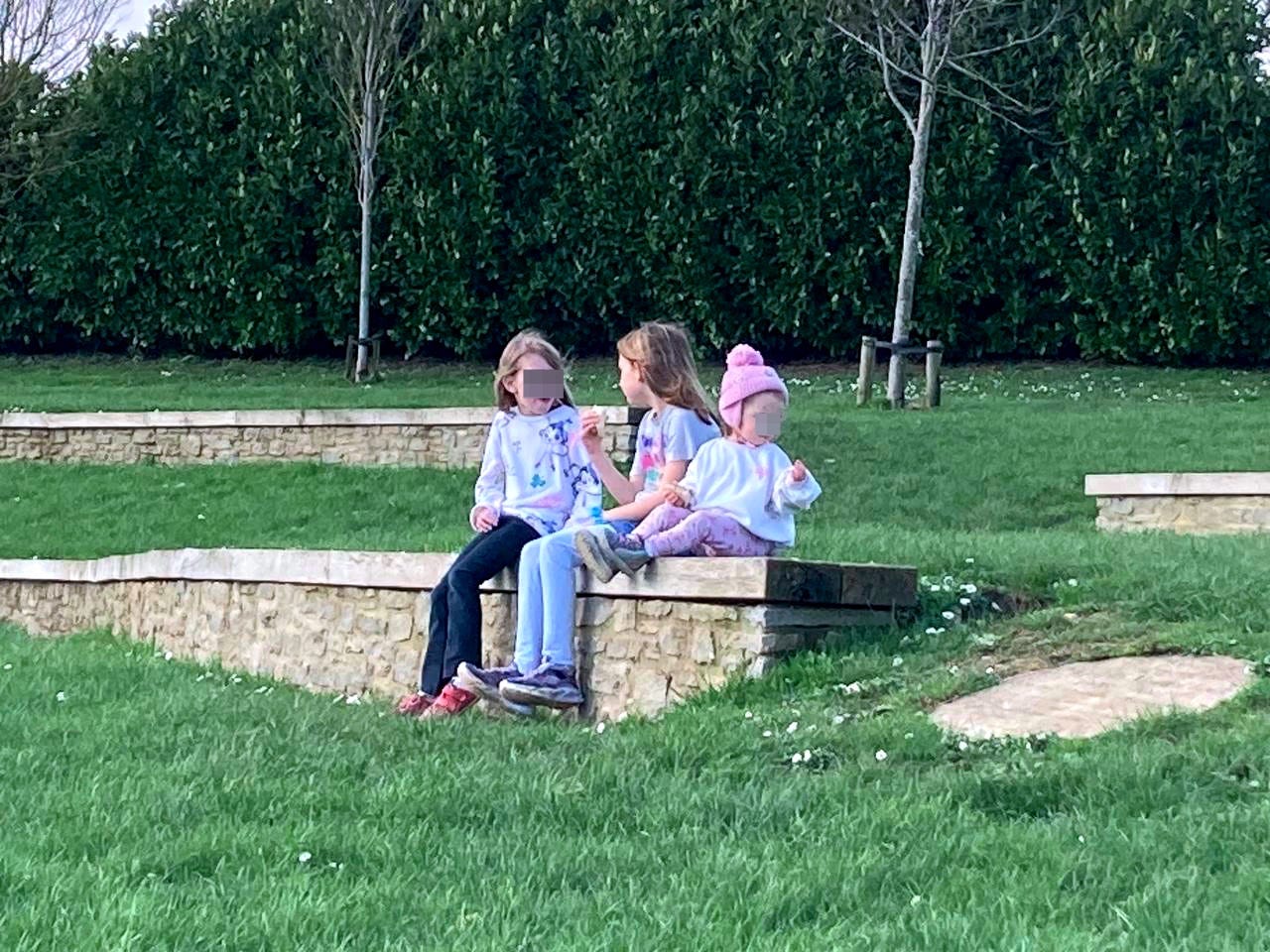
Those spaces provide materials and inspiration, but the children are largely free to follow their own ideas. More often than not, that means elaborate role-play games or collaborative adventures that no adult could have designed quite so imaginatively.
Watching this reminds me again that learning is often happening most powerfully when it looks least like teaching.
Closing
These are this month’s field notes — small moments that quietly shape how we continue walking the natural learning path.
Again and again, they remind me that learning, like childhood itself, deepens when we stop pushing and start paying attention.
If something here resonated with you, I’d love to hear: what small moment has shaped learning in your home lately?
If it might resonate with someone else walking a similar path, feel free to share it with them too.
Until next time,
Gem 💎
Subscribe below to receive future essays exploring what we see, what we miss, and what becomes possible when we look again at children and childhood.
Thank you for this gentle and thoughtful reflection on learning in everyday life. I especially appreciated the way you described small rhythms—sensory play, shared breakfasts, spontaneous math questions—because those moments reveal how learning often grows quietly rather than dramatically.
Natural learning environments work probably because they allow curiosity to lead before instruction arrives. When a child encounters a concept through play or daily life first, the formal explanation later feels like recognition rather than obligation. In that sense, curiosity may not just motivate learning—it prepares the mind to recognize meaning when it appears.
I love this! Watching my kids and their homeschool friends play and figure out “what comes next” reminded me how much learning happens when we step back and let curiosity guide.